Showing posts with label climate change. Show all posts

Wednesday, April 29, 2026

Ventura WaterPure: repeating the mistakes of the past

An opinion piece published in local papers in support of the Ventura WaterPure recycling plant misses the most important concern; by locating it in the floodplain, this expensive infrastructure is not considering the cost to future generations.  Ironically, the same issue of the Breeze includes an article titled "The Great Flood Ventura County 1969 – A Cautionary Tale?"  The letter to the editor below connects the dots.


https://venturabreeze.com/environmental-concerns-future-water-supply/


 RE: Why VenturaWaterPure matters to my generation

Sarabelen Lopez April 22, 2026

Sarabelen is so right, “nature isn’t just part of the scenery.” In Ventura we are blessed with two rivers and the Pacific Ocean, but it seems we keep making the same mistakes.

More than thirty years ago, the City of Ventura constructed a bike path right on the shoreline at Surfers Point. The ocean soon reclaimed the beach, and it took decades to undo the mistake. Today the relocated bike path is protected by imported cobble and constructed dunes that are much more than just scenery. In the end, that $200,000 bike path cost $20 million to fix, entirely because decision makers did not understand and respect the forces of nature.

Unfortunately the City of Ventura is planning to repeat the same mistake, only this time billions of dollars are on the line.   In "The Great Flood Ventura County 1969” the Santa Clara River jumped its banks and flowed through the wastewater treatment plant and into the Ventura marina. Broken pipes spilled raw sewage into the ocean for weeks. 

Now Ventura has decided that the WaterPure plant should be built right in the path of this historic flood. Only this time it’s different. It is well established that climate change will cause sea levels to rise by many feet over the coming century. Combined with ever more powerful atmospheric rivers, this location will be subject to unimaginable flooding. 

Rather than doubling down on this hazardous site, the city should be planning to relocate all water and wastewater infrastructure to higher ground out of harms way. To do anything else is an insult to the next generation.

- Paul Jenkin


In the News: 

Why VenturaWaterPure matters to my generation | Your Turn, Sarabelen Lopez, Ventura County Star, April 21, 2026


https://venturabreeze.com/the-great-flood-ventura-county-1969-a-cautionary-tale/


https://efiling.energy.ca.gov/GetDocument.aspx?tn=219169&DocumentContentId=19060
Technical Memorandium Mandalay Generating Station Modeling Support


Monday, March 30, 2026

Perils of Imported Water


Letters: March 2026

RE: ‘Flowing Into the Future’

Your article highlights the ways local water districts are connecting together in the name of “resiliency.” On the surface this might make sense, but reading between the lines reveals the harsh reality for the Ventura River watershed, which has historically been securely independent of imported water.

Casitas Municipal Water District’s connection to Carpinteria will theoretically “allow water from the California State Water Project (SWP), constructed in the 1960s and 1970s, to flow from Santa Barbara County to Ventura County for the first time ever.” And on the other side of town, the city of Ventura’s connection to Callegus MWD also provides a connection from Lake Casitas to the State Water Project.

Calleguas MWD is honest when they say, “The Colorado River has been in an epochal drought” due to ever less snowpack in the headwaters. Climate change is also affecting the State Water Project, which relies on the dwindling Sierra snowpack. Not to mention subsidence in the Central Valley and the risk of ground-shifting earthquakes, these mega-systems are highly vulnerable and becoming less reliable.

Who really thinks it’s a good idea to tie into these failing systems? Our neighbors in Los Angeles County have seen the writing on the wall, and are investing heavily on capturing stormwater and enhancing their groundwater storage.

The SWP is heavily over-allocated, so this “paper water” merely provides cover for increased demand and new development, with no regard for the local sustainability of our existing communities.

So when the State Water Project fails to deliver for our neighbors in Thousand Oaks or Carpinteria, who will they turn to? Lake Casitas and all the water diligently saved by our conservation-minded community. 

- Paul Jenkin


Background:

The Ventura River Watershed Management Plan – watershed’s first comprehensive management plan – was approved by the Watershed Council on March 5, 2015.  At that time, and as a result of many collaborative meetings with all agencies present in the room, the consensus was that the resiliency of the watershed depended upon wise water management and independence from imported water.  This became the fundamental goal of the watershed plan:


Update July 2026:

Ventura approved a $44.7 million contract to connect to the state water system despite a protest from a bidderVC Star 7/15/2026 (paywall)

(Story updated to correct the total estimated cost of the state water interconnection project to approximately $57.8 million)

CalTrans notice 7/24/2026

SANTA BARBARA COUNTY — Travelers on Highway 192 in Carpinteria will encounter a full overnight closure Monday, July 27. This full closure will take place Monday, July 27 from 8 pm to 6 am between Shephard Mesa Road and Highway 150.

Crews will perform installation of a bidirectional potable water transmission main connecting Casitas Municipal Water District in Ventura County and Carpinteria Valley Water District in Santa Barbara County.


References:

Ventura River Watershed Management Plan, Ventura River Watershed Council, March 5, 2015

Ventura-Santa Barbara Counties Intertie, CMWD

"enable each agency to provide water to the other during emergencies"

State Water Interconnection, Ventura Water

"it would give Ventura the ability to deliver water to Calleguas during outages of imported water supplies"

In the news:

Flowing Into the Future: Water districts across Ventura County are planning for long-term use and drought resilience, Ventura County Reporter, Alex Wilson Mar 5, 2026

Letters: March 2026, Ventura County Reporter

The Colorado River is on the brink of possible forced water cuts. One thing is certain: There will be lawyers.

‘Snow-eater’ heat wave behind big Sierra melt is a look at our climate future


On this blog:


Thursday, April 25, 2024

Surfrider's Climate Action Program and Surfers' Point

On Earth Day the Surfrider Foundation announced  the Climate Action Program that aims to track and highlight on the great work of local Surfrider chapters around the country who have been working to restore their local beaches  


The Ventura County Chapter has been a leader in coastal ecosystem management, and the Surfers' Point Managed Shoreline Retreat is a featured project in the new program.  Although it took 15 years for the first phase of the project to be constructed, in 2011 the Chapter "adopted" the dune restoration portion of the project.  Hundreds of volunteer hours were dedicated to planting and maintaining the native dune habitat that is crucial to stabilizing wind-blown sand to naturally maintain the dunes.  We are hopeful that with the increased attention of the Climate Action Program that other chapters can use Surfers' Point as a model for restoring resilient shorelines around the country.     


Surfers' Point Managed Shoreline retreat project Phase 2:


The diagrams below are from the City's upcoming public outreach and illustrate the plans to relocate the damaged bike path and parking lot back to Shoreline Drive.   


Erosion at Surfers' Point continues
 requiring relocation of the bike path into the parking lot
Feb 8, 2024

Get Involved:

With construction still on track for Fall 2024, the City of Ventura is seeking public input on the public art component of the project:  

A community workshop for the Surfers Point Managed Retreat Project will be held on Thursday, May 2, at 5:30 p.m. at Santa Rosa Hall, located at the Ventura County Fairgrounds. Spanish interpretation will be available. 

"We are thrilled to involve our community in this pivotal stage of the Surfers Point Managed Retreat Project," said Mayor Joe Schroeder. "After receiving over $16 million from the State of California’s Coastal Conservancy to fund this project, community input and collaboration are crucial in creating a space that reflects the needs and aspirations of our residents and visitors for this iconic location."

This workshop presents a valuable opportunity for community members to engage in interactive discussions, activities, and collaborative sessions that will shape the amenities and potential public art themes at the Surfers Point site, among other aspects.


More on this blog:  

Surfers' Point Nature Based Solutions video

Surfers' Point


Friday, December 1, 2023

Headwaters to Ocean (H2O) Conference

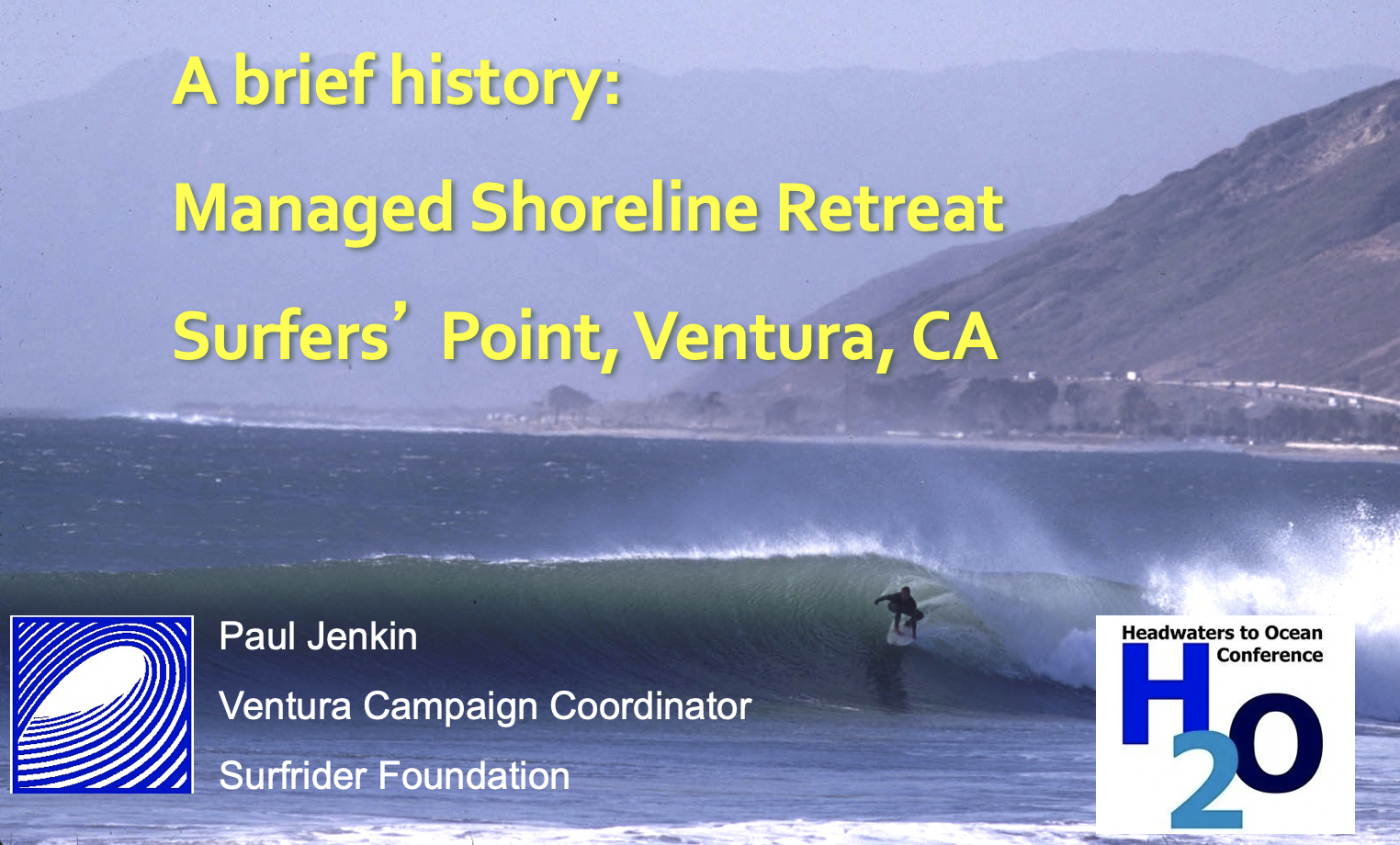
The California Shore and Beach Preservation Association (CSBPA) and Beach Erosion Authority for Clean Oceans and Nourishment (BEACON) organized the 2023 Headwaters to Ocean (H2O) Conference.  This was the first big in-person gathering of professionals involved in watershed and coastal  health, restoration, and management since the COVID pandemic.

On Tuesday November 28, BEACON convened their science advisory panel and stakeholders for a morning meeting followed by lunch and guided tour of the Surfers' Point Managed Shoreline Retreat Project.  

H2O was a two day conference held in the Crowne Plaza Hotel on Ventura Beach on November 29-30. 

The H2O conference serves as a catalyst for collaboration across various fields, industries, institutions, and organizations united by their shared interests in topics related to water, oceans, coastal environments, sediment management, resilience, and the intersections between terrestrial and marine systems.  

A session on Surfers' Point included presentations from Paul Jenkin, Surfrider Foundation, Bob Battalio, ESA, Dave Hubbard, CRC, and Kiki Patsch, CSUCI.  The talks covered the history, engineering, dunes, and monitoring.


Paul Jenkin presented the lunchtime plenary talk, "A Lifetime of Coastal Activism; A Retrospective" or "Headwaters 2 Ocean; Ventura River, a Case Study"


H2O Conference Website: https://asbpa.org/2023/08/15/h2o-2023-conference/


Thursday, October 12, 2023

Surfers' Point Nature Based Solutions video


"Fighting Climate Change with Nature," a video produced by the Surfrider Foundation featuring the Surfers' Point Managed Shoreline Retreat project:


Wednesday, August 29, 2018

California Climate Change Assessment

On August 27, 2018, the California Natural Resources Agency released California’s Fourth Climate Change Assessment.  The goal of these assessments is to "provide the scientific foundation for understanding climate-related vulnerability at the local scale and informing resilience actions. The Climate Change Assessments directly inform State policies, plans, programs, and guidance to promote effective and integrated action to safeguard California from climate change."

The Key Findings summarize the impacts on people, infrastructure, and natural systems, and "provides critical information that will enable more ambitious efforts to support a climate-resilient California."

The Fourth Assessment included a Coast and Ocean Summary Report for the first time; this report synthesizes the latest research... about the challenges facing our coast and ocean because of climate change and what actions we can take to increase their resilience.


The Fourth Assessment study found that sea-level rise has become the dominant concern for coastal managers, and most also face funding and financing barriers.


According to the LA Times,

"At Surfers Point in Ventura County, officials turned an eroding parking lot and collapsing bike path into a cobble beach backed by vegetated dune. It has fended off erosion, widened the beach and become the most visited beach in Ventura County, the report said. During high wave conditions in the winter of 2015-16, no damage occurred at the project site: Wave run-up reached the bike path only where dunes were absent.

Other parts of the local shorelines were not so lucky: Ventura Pier was damaged in the storm and the Pierpoint neighborhood suffered inundation, the report said."
                                      
This was documented on this blog: Surfers Point - first real test


More information:

California Natural Resources Agency; http://resources.ca.gov/climate/safeguarding/research/

Climate Assessment; http://www.climateassessment.ca.gov

In the news:  Climate change will be deadlier, more destructive and costlier for California than previously believed, state warns, LA Times, Aug 27, 2018


Tuesday, February 21, 2017

Surf science


The LA Times reports that last winter's  El NiƱo triggered unprecedented erosion across California's coast.

The article highlights research analyzing last year's El Nino storm track that brought us one of the best winter surf seasons on record. 


This new research confirms what we observed in Ventura: the combination of large waves and drought drove unprecedented levels of winter shoreline retreat.


the "cove" at Surfers Point in Ventura
post El Nino winter beach, 5-6-2016


the "cove" at Surfers Point in Ventura
summer beach, 6-28-2016


The drought is just one factor in sand-starved beaches.  “...we dam the rivers for flood control and say, ‘Holy crap, the sand’s not getting to the beaches anymore.”

But last year another force was in play; rising sea levels.  The paper states that "Water levels anomalies of 7–17 cm above normal were measured across the US West Coast during the El NiƱo winter of 2015–2016, similar to anticipated global mean sea-level increases expected within the next few decades."

This El NiƱo may have been a big one, but it may become “the new normal”

Which raises the question;

How will rising sea levels affect surfing in the future?

This topic is explored in a new paper titled Using local knowledge to project sea level rise impacts on wave resources in California published in the journal Ocean & Coastal Management.

This research concludes:
Map of California surf-spot vulnerability, Reineman et al

  1. Sea level rise will likely impact the quality of surf-spots; in California that impact will be a net reduction in overall wave quality at current surf-spots. 
  2. Vulnerability of surf-spots to sea level rise varies geographically, with some surf-spots and some regions experiencing more significant reductions in wave quality; due to sea level rise, roughly 18% of surf-spots evaluated here are Threatened by drowning and 16% are Endangered; 5% could improve. 
  3. Surfers' local ecological knowledge of waves constitutes a measureable source of data about environmental condition and variation. 


As sea level rises locally, surf-spots that break at low tide, or medium tide, or high-tide will be increasingly and sequentially inundated: the water will simply be too deep for them to experience their best conditions.

And perhaps most relevant to our local situation, in areas where landward migration of the beach is not permitted, either through seawalls or natural marine terraces, the beach will be "drowned."

Factors influencing surf-spot vulnerability, Reineman et al


This research relied upon surveys of thousands of surfers, who often have the best understanding of local conditions.  The paper concludes that;

Given the vast economic and cultural importance of surfing, these conclusions suggest that coastal managers should not only give credence to the wave knowledge of surfers, but also take wave quality and vulnerability into consideration, especially when planning coastal armoring, beach nourishment, or other developments, whose impacts to natural coastal processes could affect waves.


On this blog:

Surfer Magazine cover
C-St Ventura - cobble and erosion Dec 2015
Surfers Point - first real test
Surfers' Point emergency revetment


References:

El NiƱo triggered unprecedented erosion across California's coast, LA Times Feb 14, 2017

Extreme oceanographic forcing and coastal response due to the 2015–2016 El NiƱo.  Barnard, P. L. et al. Nat. Commun. 8, 14365 doi: 10.1038/ncomms14365 (2017).
http://www.nature.com/articles/ncomms14365


Using local knowledge to project sea level rise impacts on wave resources in California, Dan R. Reineman, Leif N. Thomas, Margaret R. Caldwell, Ocean & Coastal Management. Volume 138, 15 March 2017, Pages 181–191


Monday, December 14, 2015

1969 Floods and Ventura wastewater

As we prepare for 2016's predicted floods, it is interesting to look back in history.   The photos below illustrate the impact to the City of Ventura's wastewater infrastructure from the big floods of 1969.  The Santa Clara River jumped its banks and flowed around the wastewater treatment plant into the Ventura marina.  Broken pipes spilled raw sewage into the ocean for weeks.  

In many ways the wastewater treatment plant located at the mouth of the Santa Clara River continues to become increasingly vulnerable over time.  Upstream development has led to new and bigger levees, effectively channelizing the river and increasing flows near the river mouth.  Moreover, as time goes by climate change will compound the problem through increased storm intensity which will add to the threat of flood from upstream, while rising sea levels present a growing risk from the ocean.


The Olivas Park golf course was historically a productive wetland, which also provided an effective buffer to flood waters along the banks of the Santa Clara River. As illustrated below, in 1969 the river flowed right through the recently constructed golf course and into the marina.   


Solutions:  Surfrider has commented on the Santa Clara Estuary Special Studies that Ventura Water should take advantage of ongoing plans to reduce discharges into the Santa Clara Estuary through wastewater recycling, and consider developing a decentralized strategy.  This would over time reduce the volume of wastewater reaching the estuary, and increase resilience in the face of these risks.

More info:

Santa Clara River Estuary Special Studies
Ventura River Watershed - Flooding photos
...

Reference:
Ventura WaterPure, City of Ventura website

Friday, November 20, 2015

Climate.gov (another case study)


Climate.gov News and Features: https://www.climate.gov/news-features/department/climate-case-studies

Thursday, November 12, 2015
Coastal erosion has repeatedly damaged surfside bike paths and parking lots near Ventura, California. It took local groups with varying viewpoints more than a decade to agree upon a strategy, but the first phase of their solution is now complete.

Wednesday, December 18, 2013

Coastal Resilience - Ventura County


The Nature Conservancy is the lead in a study to assess potential changes to our coastline with future sea level rise and other climate change effects.

According to the website, The Nature Conservancy is leading Coastal Resilience Ventura - a partnership to provide science and decision-support tools to aid conservation and planning projects and policymaking to address conditions brought about by climate change.  The primary goals of Coastal Resilience Ventura are assessing the vulnerabilities of human and natural resources, and identifying solutions that help nature help people.

The recent report outlines a Catalogue of Local Sea Level Rise Planning Tools.  Key recommendations are:

  • Sea Level Rise should be included in General Plan
  • Sea Level Rise in should be included Local Coastal Program (LCP) Update
  • Sea Level Rise in should be included Zoning Code Updates
  • Sand Dune and Wetlands as Barriers and Buffers
  • Flexible Options: Managed retreats, Transfer of Development Rights (TDR), and project siting and design considering sea level rise

Another product of this project is a web mapping tool to help illustrate potential inundation areas from sea  level, tides, waves, and river flooding.


More info:


Friday, March 4, 2011

'Swept Away' - KCET television

KCET examines the cost and consequences of climate change to California, using the examples of Broad Beach in Malibu contrasted with the Surfers' Point Managed Shoreline Retreat project.


video platformvideo managementvideo solutionsvideo player


The program streams on the KCET website: http://www.kcet.org/shows/socal_connected

Wednesday, October 20, 2010

Capps in Santa Barbara


Congresswoman Lois Capps held a press conference in Santa Barbara yesterday. The event was focused on Prop 23, a measure on the ballot that would reverse Prop 32, the California Climate Bill.

I was invited to speak and stressed Surfrider Foundation's 'Not the Answer' campaign - the title says it all - more offshore drilling is not the answer to our energy future, and threatens the sustainable management of our coasts and oceans. And as someone who has driven both electric and biodiesel vehicles over the past decade, I recognize the potential for California to become a world leader in the new technologies that will enable a sustainable energy future...


In the news: Capps_to_lead_environmental_rally_at_shoreline_park
KEYT news


More info: No on Prop 23
Not the Answer
Who Killed the Electric Car?
Sustainable Options

Recent news: Star probe turns up more about channel oil firms

Saturday, July 3, 2010

Ventura Promenade repairs


If you were on the Promenade this weekend you probably saw the sign announcing the upcoming repair work. Surfrider had commented on this issue as far back as 2001, and it's taken the city this long to come up with the funding to do a partial fix of the aging seawall. Our concerns have been that the addition of rock will narrow the beach, and make it more hazardous.


Apart from the decaying concrete, one of the biggest maintenance problems for the city has been the stairs in the 'cove.' These are the ones we all use to get in and out of the water, and they take a beating at high tide.


The biggest change will be the removal of these stairs, to be replaced 150 ft down the beach. They will be made of timber, and set back from the beach to help resist the regular poundings from high surf.


Ironically, the public notice was placed next to one of the SLAP poles. Since the promenade was constructed in 1969, sea level has slowly risen and the beach has narrowed - increasing the impacts on the seawall. We have commented both to the city and the Coastal Commission regarding the potential for ever-increasing costs of maintaining structures on the coast in the face of rising sea levels. Time will tell how long these repairs will hold up...

Thursday, October 29, 2009

The Ventura Experiment

The Ventura Experiment
Wednesday, Oct 28th - The Green Coalition of Ventura County

A student group from the Bren School of Environmental Science and Management at UCSB presented their project which will feature Ventura as a model city working to reduce community carbon emissions. The goals of the study are to determine what to do, how to do it, and how much it will cost.

Around the world a selection of “Pioneer Cities” are undergoing similar projects. Ventura will be linked to Wuxi, a city on the Yangtse River in China. The group in Ventura on Wednesday night included a student from China, who also presented some insights from his country.

The study will have three steps. Bren students will evaluate our carbon footprint as a community. They will design a menu of strategies for reducing our greenhouse gas emissions. Then they will develop a feasibility analysis of the political and economic factors of our community. In addition to a set of recommendations for Ventura they hope to create a toolkit adoptable to other communities.

Of note was a 'wordle' taken from their initial work. (Wordles are like the label cloud on this blog, or this.) In this case, Water turned out to be the primary word. The group discussed how low flow shower heads and other water conservation measures can reduce carbon emissions - yes, saving water reduces energy used in pumping and heating the water we use on a daily basis.

The project web page has a wealth of information on the project and references on technologies and strategies. We can look for the results in the spring of 2010.

Thursday, October 15, 2009

Blog Action Day


Today is 'Blog Action Day' - this year's theme: 'Climate Change'


The Ventura Ecosystem project aims to educate local residents and decision makers about adaptation to climate change and implementing solutions to ensure a sustainable future. In the arid climate of Southern California, it's all about water...

Other posts relating to climate change

Friday, July 3, 2009

Home - the film

The big picture... our Home


http://www.youtube.com/homeproject

We are living in exceptional times. Scientists tell us that we have 10 years to change the way we live, avert the depletion of natural resources and the catastrophic evolution of the Earth's climate.

Monday, June 15, 2009

VCReporter on Water


This week's edition of the VCReporter provides a local perspective on water. The feature article, H2O Redefined speaks of climate change and the growing threat of privatization of water supplies. It also includes a plug for Watershed Revolution.


Other headlines in this issue include:

Ventura_Eyes_State_Water_Sale

New_Ventura_County_Storm_Water_Permit_Good_for_Environment_Bad_for_Development

Thirsty_Street_Trees_Need_a_Drink_of_Water_and_Some_Love_from_Neighbors

Unfortunately, the writers failed to connect the dots on these issues. Interestingly, the most relevant analysis in this issue is embedded in the editor's note:

Rethinking Water Consumption

Here the editor makes a good case for greywater, and includes a link to www.graywater.org/

Although the future of cheap permitted gray water systems in the state of California appears to be a way’s away, for those who understand the importance of conservation and our severe drought situation, gray water is the future. We need to take it upon ourselves to start advocating for new ways to save our most precious natural resource.

Indeed, this was one of the most tangible actions outlined in the 2050-plan-for-post-peak-oil-ventura. Widespread implementation of greywater would reduce the burden on our wastewater treatment plant, offset overdraft of our river and aquifers, and temper the waste of once-used water that has been treated to drinking standards. It would also create hundreds of 'green collar' jobs that would directly address our need to adapt to climate change (almost 20% of California's energy demand is in transporting and treating water.) The only thing stopping us is bureacratic inertia and overzealous regulations combined with misdirected incentives that continue to focus on centralized infrastructure.


Tuesday, June 9, 2009

Urban Design

A great opportunity to get involved with local folks getting organized:

Dear Urban Design Activists,


Here are two great events that we hope you’ll take part in!


“Urban” is not a four-letter word Thursday, June 11 6:30-8:30 Main St. Architects - 422 E. Main St., Ventura (upstairs) Free Event

Nick Deitch presents an in-depth look at what New Urbanism is, and how it could play a role right here in Ventura City. He will share slides and a wealth of knowledge from his decades of work as an involved architect, designer, and activist. Afterword there will be a chance for discussion and dialog.


“Although it might seem foreign to many of us, urban form is actually our most natural habitat. People throughout the world live comfortable fulfilling lives in urban places. Urbanism is the constant pursuit of creating, shaping and reshaping our built habitat – our neighborhoods, towns and cities. Good urbanism allows us to live closer together comfortably, with less reliance on the car and more reliance on neighborhood proximity to the stuff of daily life.” – Nick Deitch VCCool’s New Urbanism Pod

Monthly meeting
Thursday – June 18th 6:30 – 8pm Main St. Architects - 422 E. Main St., Ventura (upstairs)
This is a work and strategy meeting, so please do attend if you’re ready to roll your sleeves up, or if you think you might be ready to do so but need more info. Topics for discussion: We’re becoming more focused on promoting a city designed for enjoyment by people instead of for the storage of cars. Our last meeting sketched out a rough plan of action. Now, we need to decide on a name, vote on our new “statement of purpose,” and map out goals and objectives and milestones. Hope to see you soon. Please feel free to call if you have questions.

Warm Regards,
Rachel Morris VCCool President www.vccool.org (805)648-1267

VCCool is a Ventura County global warming action group. Our mission is to engage all people of Ventura County in promoting a healthy climate.


This event is one of a series of events that the VCCool New Urbanism pod is presenting to open the vision and the dialog for greener communities. If you have friends or people who could benefit from learning more, please invite them – this is an important chance meet and share. Please pass the word!