Showing posts with label dam removal. Show all posts

Thursday, January 25, 2024

Watching the dams come out: Klamath River

Last year the removal of four dams on the Klamath River began.  This week the fourth dam, Copco No. 1, was breached setting the stage for the physical removal of all four dams this spring and summer.

Video of the drawdown demonstrates what is becoming one of the the standard dam removal methods, blasting a hole in the lower part of the dam to drain the reservoir and release the sediments trapped upstream.


In the news:


Friday, October 20, 2023

Elwha, Dam Removal Success Story

A decade after the removal of two high dams on the Elwha River, scientists are documenting the recovery of an entire ecosystem.  The science bodes well for the recovery of the Ventura River ecosystem with the removal of Matilija Dam.

This PBS documentary tells the story: 

Undamming a river, rebuilding a forest | WILD HOPE

"Ten years after the largest dam removal in history—on the Elwha River, in Washington State—scientists are chronicling an inspiring story of ecological rebirth. Recovering salmon populations are transferring critical nutrients from the ocean into the forests along the Elwha’s banks, enriching the entire ecosystem. The Elwha’s revival is encouraging advocates to push for the removal of many larger dams in the region, and in the rest of the world."


More on this blog:  Elwha


Tuesday, May 23, 2023

Klamath River dam removal begins


After nearly two decades of planning, construction recently began on the estimated $450 million Klamath River Renewal Project.  The project involves the simultaneous removal of four dams to restore the second largest river in California.  The project is overseen by the independent nonprofit Klamath River Renewal Corporation formed in 2016 to navigate the complex regulatory and legal issues associated with dam removal.


ASCE provides a good technical summary of the project here:  Construction begins on removal of 4 Klamath River dams.  In 2009 we noted that Klamath Dam removal study supports sediment releases, and each of the four dams will utilize natural transport for disposal of the majority of the fine sediment that has accumulated in the reservoirs.  Most of the concrete and other materials will be disposed at or near each of the dam sites.  

The Klamath River suffered a dramatic and notorious fish kill in 2002 when over 34,000 fish, mostly adult fall Chinook salmon, were found dead in the Lower Klamath River. This fish kill was unprecedented for returning adult salmon on the Klamath River, profoundly affecting the Yurok People and other local residents both economically and spiritually.  The river suffered another fish kill following the fires of 2022.  The major contributing factor to unhealthy fisheries in the Lower Klamath River has been the presence of the large reservoirs which accumulate agricultural runoff and fertilizers which heat up in the hot summer months and fuel toxic algae.  Removal of these dams will eliminate the release of this toxic hot water into critical salmon habitat.  Most importantly this project will restore one of the most productive salmon runs in California to benefit the Native American communities who have depended on fisheries for their livelihood, health, and cultural practices since time immemorial. 

Also of interest is the The Klamath Mitigation Fund which "is a voluntary claims-based compensation program in which impacted property owners can participate.  The Fund is designed to provide compensation for specified physical impacts to private properties caused by the Klamath dam removal project. The Fund will be administered by independent Fund Administrators based on criteria established from extensive technical analysis. The Fund Administrators will organize information sessions by potential claim (slope stability, flood risk, and groundwater well impacts) to explain the analysis and approach. They will ultimately make independent compensation decisions and manage settlements with individual property owners for physical damages demonstrated to be caused by dam removal. Such payments (which will settle claims) will avoid the need for litigation to resolve such damages.”


In the news:   

First Klamath River dam to be removed by end of summer  

The massive dam removal on the Klamath may save salmon but can’t solve the West’s water crisis

With one down, Klamath dam removal proceeds on schedule

An Important Milestone on the Klamath – Removal of the Copco 2 Dam Complete! American Whitewater11/09/2023


On this blog:

Klamath Dam removal study supports sediment releases


Reference:

Klamath River Renewal Corporation

Klamath Mitigation Fund

Construction begins on removal of 4 Klamath River dams, ASCE 5/11/2023

The Klamath River Fish Kill of 2002 CA.gov 

Klamath River Fish Kill 2002 (Earthjustice) - YouTube video


Wednesday, March 3, 2021

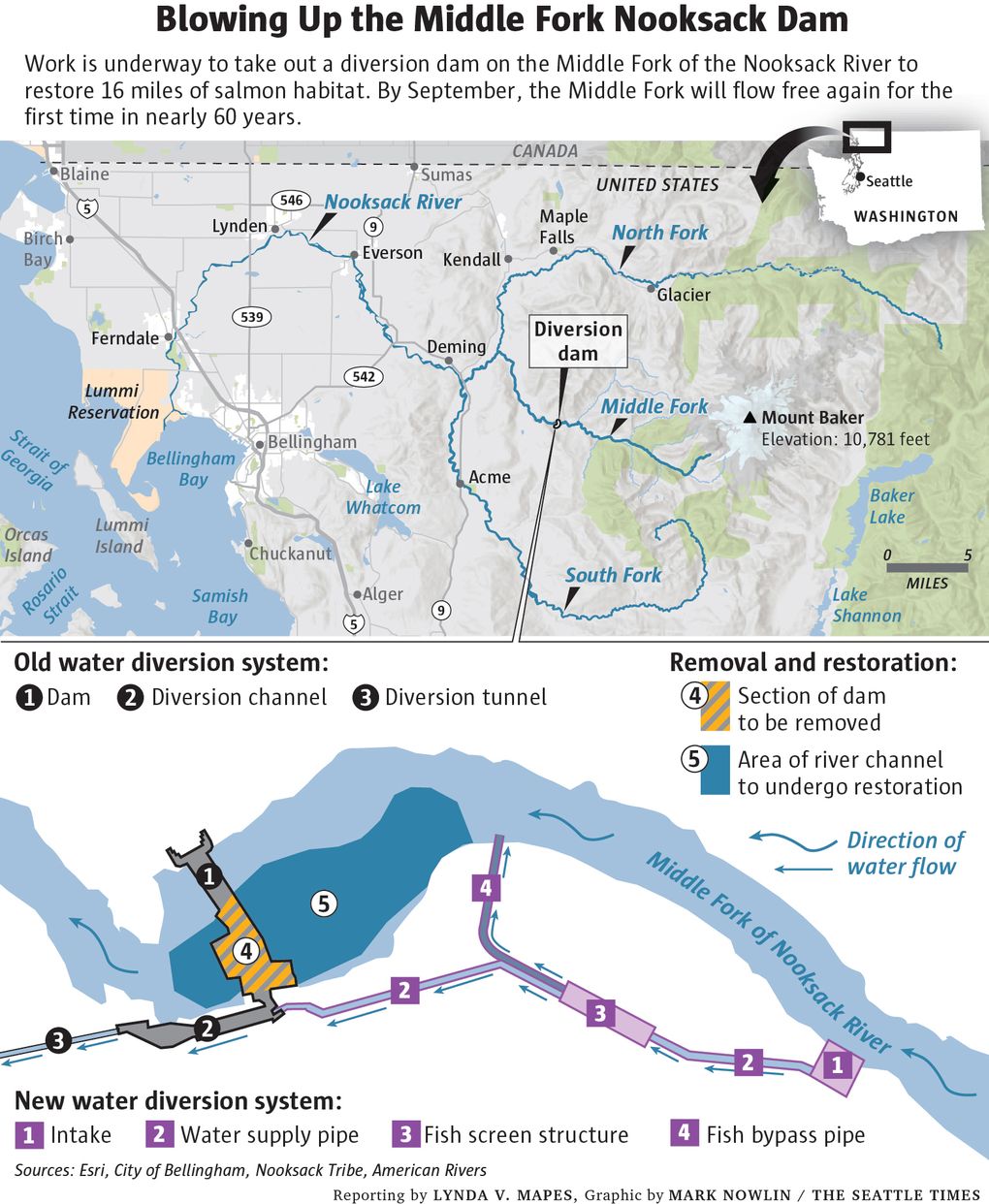
Watching the Dams Come Down: Nooksack

Another dam has been removed in the Pacific Northwest.  We have been watching and learning as our partners on the Matilija Dam project demonstrate success on other rivers.

The Middle Fork Nooksack River Fish Passage project is one of several case studies that has been examined as a strategy for modifying the Robles Diversion Dam downstream of Matilija Dam.  Diversion dams can be particularly tricky as there is a need to not only pass the increased sediment expected with Matilija Dam removal, but also maintain water diversion and fish passage.  In the Nooksack case, this is accomplished by moving water diversion intakes upstream and completely removing the existing diversion dam. 

According to the City of Bellingham, the Nooksack River Fish Passage project will restore access to approximately 16 miles of pristine spawning and rearing habitat in the upper Middle Fork for three Endangered Species Act (ESA) listed Puget Sound fish species: spring Chinook salmon, Steelhead and Bull Trout. Project elements and related benefits include​ moving the point of diversion just upstream of the existing location to eliminate the need for the dam; dam removal and channel restoration to restore habitat connectivity; and installation of fully compliant fish screens for fish protection.


In the news:

Bang! Watch a Nooksack River dam finally coming down, freeing miles for fish habitat, Seattle Times, July 20, 2020


More information:

American Rivers: reimagining-a-river-the-middle-fork-nooksack

NOAA Fisheries: dam-removal-brings-hope-salmon-washingtons-middle-fork-nooksack-river

City of Bellingham: https://cob.org/services/environment/restoration/middlefork


On this blog: 

Watching the Dams Come Down- Elwha

Watching the dams come down - Elwha beaches

Watching the Dams Come Down - Condit

Savage Rapids Dam removed

Klamath Dam removal study supports sediment releases

San Clemente Dam removal

Wednesday, April 29, 2020

Elwah steelhead success story


More good news from the Elwah River...  An article in Northwest Sportsman reveals the incredible resilience of the steelhead which have rebounded faster than predicted following the removal of two dams on the Elwah River in Washington State.  The video, "Rising from the Ashes" tells the story from the perspective of the dedicated biologists and volunteers who have undertaken annual snorkel surveys on the remote and hard to access river in the wilderness of the Olympic National Park.

The rapid recovery of the summer steelhead on the Elwah demonstrate the value of resident rainbow trout above dams.  Given the chance, even after 100 years with no possibility of returning from the ocean, these fish can make a comeback.

This is real world confirmation of the hope for recovering the endangered southern steelhead populations blocked by Matilija Dam.  With no human intervention, other than just getting out of the way, we can realize a rapid recovery of the native fish and the ecosystem on which we all rely.


New Film Highlights Elwha Summer-runs ‘Rising From The Ashes’, Northwest Sportsman, April 23, 2020

On this blog: steelhead

Tuesday, July 12, 2016

Elwha site visit 2016

This summer I had the opportunity to visit the Elwha River, my first time back since the Elwha Science Symposium and the Celebrate Elwha festival back in 2011.
 
The former Elwha dam site, June 2016
Standing above the former  Elwha dam site, faint clues of the structure are still visible across the river on the left abutment.  Unfortunately some exposed steel remains in the river channel, resulting in the closure of all boating trips through the former dam site.  A sign upstream warns of the danger and indicates a mandatory portage over the ridge.  My hopes of floating the restored river will have to wait...
Upstream of the former Elwha dam site, June 2016
This is just a quarter of a mile above the dam site.  Vegetation has grown in areas previously inundated by the reservoir, clearly delineated by the light green line below the older evergreen trees.  Most notable is the vast amount of sediment that remains on either side of the meandering river channel.  This confirms predictions that not all of the sediment trapped in the reservoirs will be moved downstream.  These new river channels will continue to adapt to future floods and slowly transport sediment out to the coast.


Elwha river delta, after dam removal June 2016

Revisiting the beaches at the mouth of the Elwha was eye opening.  Where piecemeal seawalls once protected property threatened by a receding shoreline, a 300 yard sandy delta now extends out into Puget Sound.  Numerous sea birds gathered along the river and shoreline benefiting from the renewed ecosystem, and small, clean waves hinted of the renewed surf potential.

Port Angeles
One unexpected benefit that was evident to me was the change to the little town of Port Angeles.  In 2011, this seemed like a small town with little to offer other than the port and ferry.  Since then small tourist shops and a variety of  trendy coffee shops, restaurants, and other businesses have popped up.  It seems that dam removal has been good for the local economy too!


 On this blog:

Elwah Science Symposium

Watching the dams come down - Elwha beaches


Tuesday, April 5, 2016

Watching the dams come down - Elwha beaches


Elwha River delta following dam removal, 2015
Elwha River delta at the start of dam removal in 2012

Elwha River in Washington state has received a lot of attention as the river restores itself following removal of two dams in 2011-2012.  The most dramatic changes are visible at the rivermouth, where previously eroding beaches have been replaced by a rapidly growing delta.

Check out this 360 view of rivermouth


Ventura Rivermouth following the floods of 1969
Studies estimate that the removal of Matilija Dam will increase sand and cobble
 delivery to the coast by 30% over 50 years


In the news:


Tuesday, March 22, 2016

Matilija Dam stakeholders select local project


On March 17, 2016, the Matilija Dam "Design Oversight Group" met to determine consensus around one of the three alternatives in the AECOM/Stillwater reports and how to move the project forward.

Following a long discussion, the issue was put to a vote.  Printouts depicting the three project alternatives were hung on the wall, and each stakeholder was given a green "stickie dot" to indicate their preference.  (A yellow dot was provided for a "backup" 2nd choice, if they chose to do so.)


The result was almost unanimously (95%) in favor of Dam Removal Concept 2:

0  votes  (3 backup)     -       DRC-1 Containment berm with high flow bypass = $40M
18 votes (1 backup)     -       DRC-2 Uncontrolled orifices with optional gates  = $18.5/$20.4M
1  vote    (1 backup)     -      DRC-3 Temporary upstream storage                      = $50M

This outcome was not unexpected, given the discussion during the previous meeting last September.
However, this is a very significant decision in that marks a departure from almost 15 years of discussion in which sediment was seen as damaging to both local interests and the river, and in which the Corps of Engineers was perceived as the only path to funding the project.  This vote included the local water districts, the City of Ventura, resource agencies including NOAA, Fish and Wildlife Service, State Dept of Fish and Wildlife, Army Corps of Engineers, as well as Matilija Coalition member organizations.  This method of releasing sediment through a low level outlet was demonstrated on Condit Dam in 2011.

Project Funding and Completion

The meeting agenda included discussion of the alternatives developed in the final reports and the potential funding pathways to complete the project.

This chart was presented as an outline of the processes required to complete the project.  It is assumed that Alternative 2 would be pursued as a local project, depicted by the green path, as this dam removal concept is significantly different from that which was previously authorized through the Corps of Engineers. 
Process overview for project completion presented at March 17 Matilija Dam meeting
Much talk was centered around the difficulty in funding a Corps of Engineers project given the current political climate.  Congress has restricted "new starts," and the Office of Management and Budget has kept with its determination that, when it comes to a locally owned facility such as Matilija Dam, the federal interest is limited.  In hindsight it is clear that delays in the project resulted in a missed opportunity following authorization through WRDA 2007 (the Water Resources and Development Act is the mechanism for Congress to approve Corps of Engineers projects nationwide.)
 
Matt Stoecker (DamNation), Hans Cole (Patagonia Inc) and Paul Jenkin (Matilija Coalition) at the White House Council on Environmental Quality offices in Washington DC, March 3, 2016
This sentiment was confirmed in discussions with congressional representatives and appropriation staff during a recent trip to Washington sponsored by Patagonia as part of their DamNation campaign to gain support for the removal of "Deadbeat Dams."

The project selected is by far the most cost effective means to remove Matilija Dam, and is free from congressional roadblocks.  However, despite less than $20M cost for dam removal, the total price tag will likely include tens of millions more in downstream projects previously determined necessary to accommodate restored sediment flows down the river.

Next Steps:

The next step is to identify and secure funding to complete the necessary engineering and environmental permitting to get the project "shovel ready."  This work will likely take another couple of years.  In the mean time, Patagonia has been appointed to lead a funding subcommittee to help secure funding for project implementation. 


More info:
matilijadam.org: the final Dam Removal Concepts and Water Supply Mitigation Options reports are posted to the website.  They contain final changes to the reports, mostly in response to comments submitted by members of the Design Oversight Group.

On this blog:   http://venturaecosystem.blogspot.com/search/label/Matilija%20Dam

On the web:  Matilija-Coalition.org

In the News: 


Wednesday, June 11, 2014

DamNation film


Patagonia's film about our nation's dam problem has been on tour this spring and racking up the awards:
Winner – SXSW Audience Choice Award
Winner – Documentary Award for Environmental Advocacy, DC Environmental Film Festival
Winner – Mountainfilm Audience Choice Award
Winner – Best of Festival, 5Point Film Festival

On Thursday, June 5, Patagonia presented the award-winning, feature length documentary DamNation,  at Patagonia Retail Stores in 23 cities nationwide.

Our local Great Pacific Iron Works sponsored the evening event in Ventura.  The community came out in force, over 500 people packed into the outdoor "tin shed" courtyard behind the retail store.  After the film the Q&A featuring Yvon Chouinard and Paul Jenkin drew many informed questions from an audience that was fired up to help remove our local deadbeat dam, Matilija Dam.  Proceeds from the sales of donated Stone Brewery beer and a Patagonia product raffle went to support the Matilija Coalition!

The Matilia Coalition was also part of the May 21 showing at the Lobero Theater in Santa Barbara.  That event also sold out with over 600 attending!

Starting on June 6, DamNation is now available at Vimeo On Demand for digital viewing. DamNation will be available to rent ($5.99) or buy ($9.99) for viewing on almost any device.  Also check out the Patagonia Collection on Vimeo On Demand.

Surrounding the film’s appearances at festivals and other events around the country since March, Patagonia has asked people to get involved and ask President Obama to authorize studies on removing four problematic lower dams on the Snake River. To date, over 25,000 people have signed the petition asking the administration to “crack down on deadbeat dams” – signatures that will be delivered to the White House at a later date.

Since its world premiere at the SXSW Film Festival on March, DamNation has been hailed by The Los Angeles Times, The Village Voice, National Geographic and Time Magazine. Patagonia founder Yvon Chouinard recently published an op-ed in The New York Times arguing for the removal of low value, high cost dams.

Aside from telling the story of our endanger salmon runs and the recent large dam removals, the film is a must-see for anyone with lingering curiosity about the scissors on Matilija Dam!

More:  damnationfilm.com


...

Monday, November 7, 2011

Watching the Dams Come Down- Elwha


The Elwha dam removal project is moving ahead rapidly.

Here a timelapse video shows the process of removing Glines Canyon Dam by 'notching':


Elwha Dam, the lower of the two dams on the Elwha River, is being removed by diverting the river and deconstructing one side at a time:


This video shows the spillway being blasted


Elwha Dam from the air:


The sediment built up in the upper reservoir is being exposed and eroded by the river as the water level in the reservoir is drawn down:


(aerial photos courtesy Brian Cluer)


Wednesday, October 26, 2011

Watching the Dams Come Down - Condit

Today a hole was blasted in the base of Condit Dam, allowing sediment to flush out as the reservoir drains.  These images are frame grabs from the real-time streaming video http://www.msilive.net/condit.html:

Condit Dam shortly after a hole was blasted in its base 
The view from downstream of Condit Dam
shortly after a hole was blasted in the base

River cutting through sediment upstream of Condit Dam


Sediment-laden water flushing downstream shortly after Condit Dam blast

Condit Dam after the blast - note the hole at the base of the dam

Monday, September 26, 2011

Watching the dams come down

The Elwha River restoration project can be viewed real time via a set of web cams.

http://www.video-monitoring.com/construction/olympic/js.htm


Here's the latest from today, just a week into the project:

Deconstruction of Glines Canyon Dam


Deconstruction of Elwha Dam


Graphics from the Seattle Times  


Friday, September 23, 2011

Elwha River dam removal


Last week, while attending the Elwha Science Symposium, I was able to visit the reservoir above Elwha Dam with the scientists who are studying the effects of dam removal on the sediment that has accumulated in the reservoir.  There are actually two dams being removed simultaneously from the river, Glines Canyon and Elwha Dam, the latter being the lower dam on the River.

The big question with all dam removal projects is sediment management.  The total sediment that has accumulated behind these two dams amounts to over 24 million cubic yards.  Since the upper reservoir, Lake Mills, has been trapping the majority of the coarse sand and gravel flowing down the river, the lower reservoir has trapped less material, the majority of it 'fine' clay and silt.


For the removal of the two dams on the Elwha River, the plan is for natural transport, with incremental notching of the dams to allow the river to rework the sediments.  This summer, both reservoirs were drawn down, or drained, about 20 feet.  This has provided an opportunity to document the initial changes to the delta sediment that has been deposited in the upper end of the reservoirs.

Reservoir sediments at the delta of Lake Aldwell, upstream of Elwha Dam.
Puget Sound is visible in the distance.


In order to document the current topography of the sediments, scientists from the USGS are using ground-based LiDAR, which is basically a terrestrial laser scanner. It takes 4400 points per second using a pulsed near-infrared laser. The scanner was set up at different locations around the delta, then all the scans were linked together and to real-world coordinates using a survey grade GPS.  The result is this otherworldly image, as well as a set of data that accurately models the surface of the ground and surrounding features.


LIDAR image of reservoir sediments provides accurate surface topography data


LIDAR image of Brian Cluer and Paul Jenkin on reservoir sediments


Wider view of Brian and Paul on the reservoir delta sediments


Of interest to those of us working on Matilija Dam is the impacts to water quality during and following erosion of the reservoir sediments.  The fear has been that erosion of fine silt and clay will result in chronic turbidity and downstream impacts.  The reality is that this impact is short-lived during periods of active erosion, but water quality improves rapidly thereafter.   This was evident while standing on the muddy delta in Lake Aldwell, watching crystal clear water flowing over and through the fine sediments.

Blair Greiman, USBR hydrology analyst, observes post-drawdown erosion
 of fine sediments in Lake Aldwell above Elwah dam, WA.


other venturariver.org blog posts on Elwha:

Ventura River Ecosystem: Elwah Science Symposium
Last Dam Summer


Wednesday, September 21, 2011

Elwah Science Symposium

Barge begins demo of concrete to create the first 'slot'
in Glines Canyon Dam


Deconstruction of two dams on the Elwha River in Washington State has begun.

This past week, one of the largest ever gatherings of dam removal experts and advocates came together to celebrate the biggest dam removal project in history.  The agenda included a 2-day science symposium, educational tours, music, storytelling.  The invitation-only ceremony at the dam site included the coalition that made the project possible, as well as dignitaries such as Secretary of the Interior Ken Salazar.

The science symposium drew over 300 participants and included 32 presentations on sediment, salmon, sea otters, black bears, birds and estuary morphology.  


A common theme was the importance of good science, not only in planning and engineering, but also in tracking and ensuring the effectiveness of the project as it evolves.  This was emphasized in one the the first talks by James Karr, Professor Emeritus at the University of Washington.  He stressed the need for "adaptive management"  as a key component of Ecosystem-based Management in a "Plan - Do - Check - Adjust" loop.  Other presenters echoed the need for humility and objectivity to adjust to unforeseen outcomes, as preconceived notions often underestimate the remarkable resilience of nature.


An evening session was coordinated by Matt Stoecker, and included several Patagonia-sponsored videos and a talk by Yvon Chouinard.    


To read more and see an interactive graphic of the dam removal  this LATimes article and the Special report from the Seattle Times.

In the news: 

Largest U.S. Dam Removal to Restore Salmon Runs

Dam Removal Graphic


Elwha Science Symposium on the web: http://elwharesearchconsortium.wildapricot.org/


The presentations and agenda may be downloaded here: http://elwharesearchconsortium.wildapricot.org/Resources/Documents/Elwha%20Symposium%20Program.pdf


Thursday, February 17, 2011

Hemlock Dam Removal

Around the country, more dams are being removed today than are being built. One example of a successful project is Hemlock Dam Removal on the Columbia River system.


This video showed in this year's Wild & Scenic Film Festival, and documents this project:


Of note in this video:
  • Sediment management included excavation of a new channel upstream of the dam and trucking material off-site
  • Site restoration utilized on-site trees removed from the project area as well as additional imported logs
  • Community restoration involving local schools for re-vegetation of the project area
  • Steelhead returned immediately once flows were re-introduced into the restored channel


More information:

Hemlock Dam Removal and Trout Creek Restoration Project
Sediment Impact Analysis for the Proposed Hemlock Dam Removal Project

Tuesday, February 15, 2011

Next steps - Notching?


'Just Notch It'

No matter who you speak with about Matilija Dam, the question always comes up; "Why not just take the dam down a bit at a time and let the river gradually remove the sediment?"

Indeed, one of the newspaper editorials this summer suggested "that the dam be notched down to the top of the silt in 2011 so that all future rain waters and silt in the drainage shed will flow to the ocean, like before the dam was constructed."

And Patagonia's Yvon Chouinard weighed in with, "Notching it down bit by bit, year after year... That's what I think is the solution."

Even a 3rd-grader suggested notching during a class presentation almost a decade ago. So it would seem like a logical approach.

In the world of sediment management alternatives for dam removal, notching is categorized under 'Natural Transport' - or in more simple terms, let the river do the work.


In the last decade much progress has been made with analysis and demonstrations of natural transport. This information is summarized in a document produced for the Matilija Workgroup by Matt Stoecker. And this summer, in the biggest project of its kind, the removal of two dams on the Elwah River in Washington State will begin, one notch at a time.


So why not?

The "Matilija Dam Fine Sediment Workgroup" has completed two meetings so far. Although much of this time has been spent on process (goals, who is at the table, voting structure, etc.) there has been some discussion on where we are, how we got there, and what that means for future options. The Army Corps of Engineers presentations on this topic may be downloaded at www.matilijadam.org

Currently there is a plan for the removal of Matilija Dam, its components described in the poster we printed last year. This plan is the result of a multi-year feasibility process that began in 2000, achieved consensus and local signoff in 2004, and made it all the way up through the ranks to ultimately gain congressional authorization in WRDA 2007.

Changes to the federal plan will require re-approval, the level of which will depend on how drastic any changes may be. A minor change may only require local approval, while more significant changes would trigger additional environmental review, and perhaps congressional re-authorization.


The Corps state that their design goals have been to:
  • Hold Project Cost
  • Conform to Environmental Documents
  • Constructability
  • Expedite Schedule
An explanation of the Corps thinking behind fine sediment management is shown in the diagram below. Cost overruns were stated as the primary reason the Corps did not implement the 2004 consensus plan for the temporary disposal of fine sediments at (BRDA - Baldwin Road Disposal Areas.) Permanent disposal at MODA - Meiners Oaks Disposal Area was seen as preferable, but encountered community opposition. The more recent USA - Upstream Sediment Areas was an even greater departure from the approved plan, and drew even heavier public scrutiny.


Now, taking a broader look at potential alternatives, the Corps estimates that the additional studies and review for Natural Transport would take another decade and cost up to $7M.


The other major consideration with natural transport is the reason the project got so complex in the first place: Robles Diversion Dam. The feasibility plan called for dredge-and-slurry of the fine sediments that are concentrated immediately upstream of Matilija Dam, so as to bypass Robles Diversion and eliminate any threat to the water supply in Lake Casitas. This concern still exists, along with the concerns of the other water agencies at the table.


What Next?

The immediate next step is for the Matilija Dam Fine Sediment Workgroup to work through the facilitated process and come to a common understanding of potential solutions. This would hopefully lead to a consensus on next steps, including the technical studies needed to determine the feasibility of any modifications to the approved plan. (It may be that the group simply agrees to pursue final design of the approved BRDA plan.)

But if we are truly committed to removing Matilija Dam, funding a $150M+ project is an even bigger hurdle. The project is still lacking the commitment for almost $100M in federal funding. The majority of the non-federal matching funds is expected to come from the State, but this, too, may be a long time coming in the current era of budget cuts.


Moving Forward

There may be ways to greatly reduce the overall price tag of the project if some degree of natural transport is used. At the very least, the dam should be notched down to the current silt level to avoid any further accumulation of sediment. Studies predict that the dam will trap an additional 3 million cubic yards of sediment, or half again as much as currently sits in Matilija Canyon; thus every major rain event increases the eventual cost of dam removal.

The Feasibility Study did also analyze a 2-phase notching scenario, so there may be ways to tag onto this analysis without triggering complete re-authorization.

The Matilija Coalition has consistently advocated that cost effectiveness and ecosystem restoration go hand-in-hand. Last year we published an array of alternatives titled "Sediment Management and Restoration Opportunities for the Matilija Dam Ecosystem Restoration Project" This document suggests ways that sediment management may be optimized within the context of the feasibility plan to avoid impacts and maximize cost effectiveness.

Note that the Corps' objective has always been 'disposal' of sediments - with an strong preference to permanent landfills. However, another way of looking at this is to recognize the role of sediment in the ecosystem, and devise a means to make use of this resource and reintroduce it in a controlled manner.

There is no question that letting the river do the work will cut costs. Whether these concepts can advance remains to be seen.

The next meeting of the Matilija Dam Fine Sediment Workgroup is scheduled for Thursday Feb 24, 2011.


More information:

Friday, August 27, 2010

Last Dam Summer


Good news on dam removal in the State of Washington:

Last April, Olympic National Park began distributing 5,000 "Last Dam Summer" buttons.

Park officials were heralding the 2011 tear-down of the Elwha River's two dams, an estimated $350 million history-making effort to reopen 65 miles of spawning habitat to restore the waterway's once vigorous, now tepid salmon run.

"This is the last summer before big changes come to the Elwha Valley," Olympic National Park spokeswoman Barb Maynes said last week.

The first big change comes in about a week, when Lake Mills closes to the public for eight weeks while a pilot channel is dug to route sediment once 210-foot Glines Canyon Dam and 108-foot Elwha Dam do come down.

The dams' actual demise will not begin until Sept. 15, 2011. The project is scheduled to end by March 2014.


http://www.peninsuladailynews.com/apps/pbcs.dll/article?AID=2010308229993#


More info on the Elwah Dam project here: http://www.nps.gov/olym/naturescience/elwha-ecosystem-restoration.htm

Sunday, January 31, 2010

San Clemente Dam moves forward


Recent news on San Clemente Dam:

The headline reads: Deal struck to tear down 106-foot dam; would be largest dam removal in California.

"A $150 million project to tear down the 165-foot Matilija Dam in Ventura County, which is also silted up, was approved in 2004 by county officials, but has not been implemented yet because of funding shortfalls.

The question is which one will get the permits and the funding to go first."