Showing posts sorted by relevance for query elwha. Sort by date Show all posts

Tuesday, April 5, 2016

Watching the dams come down - Elwha beaches


Elwha River delta following dam removal, 2015
Elwha River delta at the start of dam removal in 2012

Elwha River in Washington state has received a lot of attention as the river restores itself following removal of two dams in 2011-2012.  The most dramatic changes are visible at the rivermouth, where previously eroding beaches have been replaced by a rapidly growing delta.

Check out this 360 view of rivermouth


Ventura Rivermouth following the floods of 1969
Studies estimate that the removal of Matilija Dam will increase sand and cobble
 delivery to the coast by 30% over 50 years


In the news:


Tuesday, July 12, 2016

Elwha site visit 2016

This summer I had the opportunity to visit the Elwha River, my first time back since the Elwha Science Symposium and the Celebrate Elwha festival back in 2011.
 
The former Elwha dam site, June 2016
Standing above the former  Elwha dam site, faint clues of the structure are still visible across the river on the left abutment.  Unfortunately some exposed steel remains in the river channel, resulting in the closure of all boating trips through the former dam site.  A sign upstream warns of the danger and indicates a mandatory portage over the ridge.  My hopes of floating the restored river will have to wait...
Upstream of the former Elwha dam site, June 2016
This is just a quarter of a mile above the dam site.  Vegetation has grown in areas previously inundated by the reservoir, clearly delineated by the light green line below the older evergreen trees.  Most notable is the vast amount of sediment that remains on either side of the meandering river channel.  This confirms predictions that not all of the sediment trapped in the reservoirs will be moved downstream.  These new river channels will continue to adapt to future floods and slowly transport sediment out to the coast.


Elwha river delta, after dam removal June 2016

Revisiting the beaches at the mouth of the Elwha was eye opening.  Where piecemeal seawalls once protected property threatened by a receding shoreline, a 300 yard sandy delta now extends out into Puget Sound.  Numerous sea birds gathered along the river and shoreline benefiting from the renewed ecosystem, and small, clean waves hinted of the renewed surf potential.

Port Angeles
One unexpected benefit that was evident to me was the change to the little town of Port Angeles.  In 2011, this seemed like a small town with little to offer other than the port and ferry.  Since then small tourist shops and a variety of  trendy coffee shops, restaurants, and other businesses have popped up.  It seems that dam removal has been good for the local economy too!


 On this blog:

Elwah Science Symposium

Watching the dams come down - Elwha beaches


Friday, September 23, 2011

Elwha River dam removal


Last week, while attending the Elwha Science Symposium, I was able to visit the reservoir above Elwha Dam with the scientists who are studying the effects of dam removal on the sediment that has accumulated in the reservoir.  There are actually two dams being removed simultaneously from the river, Glines Canyon and Elwha Dam, the latter being the lower dam on the River.

The big question with all dam removal projects is sediment management.  The total sediment that has accumulated behind these two dams amounts to over 24 million cubic yards.  Since the upper reservoir, Lake Mills, has been trapping the majority of the coarse sand and gravel flowing down the river, the lower reservoir has trapped less material, the majority of it 'fine' clay and silt.


For the removal of the two dams on the Elwha River, the plan is for natural transport, with incremental notching of the dams to allow the river to rework the sediments.  This summer, both reservoirs were drawn down, or drained, about 20 feet.  This has provided an opportunity to document the initial changes to the delta sediment that has been deposited in the upper end of the reservoirs.

Reservoir sediments at the delta of Lake Aldwell, upstream of Elwha Dam.
Puget Sound is visible in the distance.


In order to document the current topography of the sediments, scientists from the USGS are using ground-based LiDAR, which is basically a terrestrial laser scanner. It takes 4400 points per second using a pulsed near-infrared laser. The scanner was set up at different locations around the delta, then all the scans were linked together and to real-world coordinates using a survey grade GPS.  The result is this otherworldly image, as well as a set of data that accurately models the surface of the ground and surrounding features.


LIDAR image of reservoir sediments provides accurate surface topography data


LIDAR image of Brian Cluer and Paul Jenkin on reservoir sediments


Wider view of Brian and Paul on the reservoir delta sediments


Of interest to those of us working on Matilija Dam is the impacts to water quality during and following erosion of the reservoir sediments.  The fear has been that erosion of fine silt and clay will result in chronic turbidity and downstream impacts.  The reality is that this impact is short-lived during periods of active erosion, but water quality improves rapidly thereafter.   This was evident while standing on the muddy delta in Lake Aldwell, watching crystal clear water flowing over and through the fine sediments.

Blair Greiman, USBR hydrology analyst, observes post-drawdown erosion
 of fine sediments in Lake Aldwell above Elwah dam, WA.


other venturariver.org blog posts on Elwha:

Ventura River Ecosystem: Elwah Science Symposium
Last Dam Summer


Friday, October 20, 2023

Elwha, Dam Removal Success Story

A decade after the removal of two high dams on the Elwha River, scientists are documenting the recovery of an entire ecosystem.  The science bodes well for the recovery of the Ventura River ecosystem with the removal of Matilija Dam.

This PBS documentary tells the story: 

Undamming a river, rebuilding a forest | WILD HOPE

"Ten years after the largest dam removal in history—on the Elwha River, in Washington State—scientists are chronicling an inspiring story of ecological rebirth. Recovering salmon populations are transferring critical nutrients from the ocean into the forests along the Elwha’s banks, enriching the entire ecosystem. The Elwha’s revival is encouraging advocates to push for the removal of many larger dams in the region, and in the rest of the world."


More on this blog:  Elwha


Monday, November 7, 2011

Watching the Dams Come Down- Elwha


The Elwha dam removal project is moving ahead rapidly.

Here a timelapse video shows the process of removing Glines Canyon Dam by 'notching':


Elwha Dam, the lower of the two dams on the Elwha River, is being removed by diverting the river and deconstructing one side at a time:


This video shows the spillway being blasted


Elwha Dam from the air:


The sediment built up in the upper reservoir is being exposed and eroded by the river as the water level in the reservoir is drawn down:


(aerial photos courtesy Brian Cluer)


Wednesday, September 21, 2011

Elwah Science Symposium

Barge begins demo of concrete to create the first 'slot'
in Glines Canyon Dam


Deconstruction of two dams on the Elwha River in Washington State has begun.

This past week, one of the largest ever gatherings of dam removal experts and advocates came together to celebrate the biggest dam removal project in history.  The agenda included a 2-day science symposium, educational tours, music, storytelling.  The invitation-only ceremony at the dam site included the coalition that made the project possible, as well as dignitaries such as Secretary of the Interior Ken Salazar.

The science symposium drew over 300 participants and included 32 presentations on sediment, salmon, sea otters, black bears, birds and estuary morphology.  


A common theme was the importance of good science, not only in planning and engineering, but also in tracking and ensuring the effectiveness of the project as it evolves.  This was emphasized in one the the first talks by James Karr, Professor Emeritus at the University of Washington.  He stressed the need for "adaptive management"  as a key component of Ecosystem-based Management in a "Plan - Do - Check - Adjust" loop.  Other presenters echoed the need for humility and objectivity to adjust to unforeseen outcomes, as preconceived notions often underestimate the remarkable resilience of nature.


An evening session was coordinated by Matt Stoecker, and included several Patagonia-sponsored videos and a talk by Yvon Chouinard.    


To read more and see an interactive graphic of the dam removal  this LATimes article and the Special report from the Seattle Times.

In the news: 

Largest U.S. Dam Removal to Restore Salmon Runs

Dam Removal Graphic


Elwha Science Symposium on the web: http://elwharesearchconsortium.wildapricot.org/


The presentations and agenda may be downloaded here: http://elwharesearchconsortium.wildapricot.org/Resources/Documents/Elwha%20Symposium%20Program.pdf


Friday, August 27, 2010

Last Dam Summer


Good news on dam removal in the State of Washington:

Last April, Olympic National Park began distributing 5,000 "Last Dam Summer" buttons.

Park officials were heralding the 2011 tear-down of the Elwha River's two dams, an estimated $350 million history-making effort to reopen 65 miles of spawning habitat to restore the waterway's once vigorous, now tepid salmon run.

"This is the last summer before big changes come to the Elwha Valley," Olympic National Park spokeswoman Barb Maynes said last week.

The first big change comes in about a week, when Lake Mills closes to the public for eight weeks while a pilot channel is dug to route sediment once 210-foot Glines Canyon Dam and 108-foot Elwha Dam do come down.

The dams' actual demise will not begin until Sept. 15, 2011. The project is scheduled to end by March 2014.


http://www.peninsuladailynews.com/apps/pbcs.dll/article?AID=2010308229993#


More info on the Elwah Dam project here: http://www.nps.gov/olym/naturescience/elwha-ecosystem-restoration.htm

Wednesday, March 3, 2021

Watching the Dams Come Down: Nooksack

Another dam has been removed in the Pacific Northwest.  We have been watching and learning as our partners on the Matilija Dam project demonstrate success on other rivers.

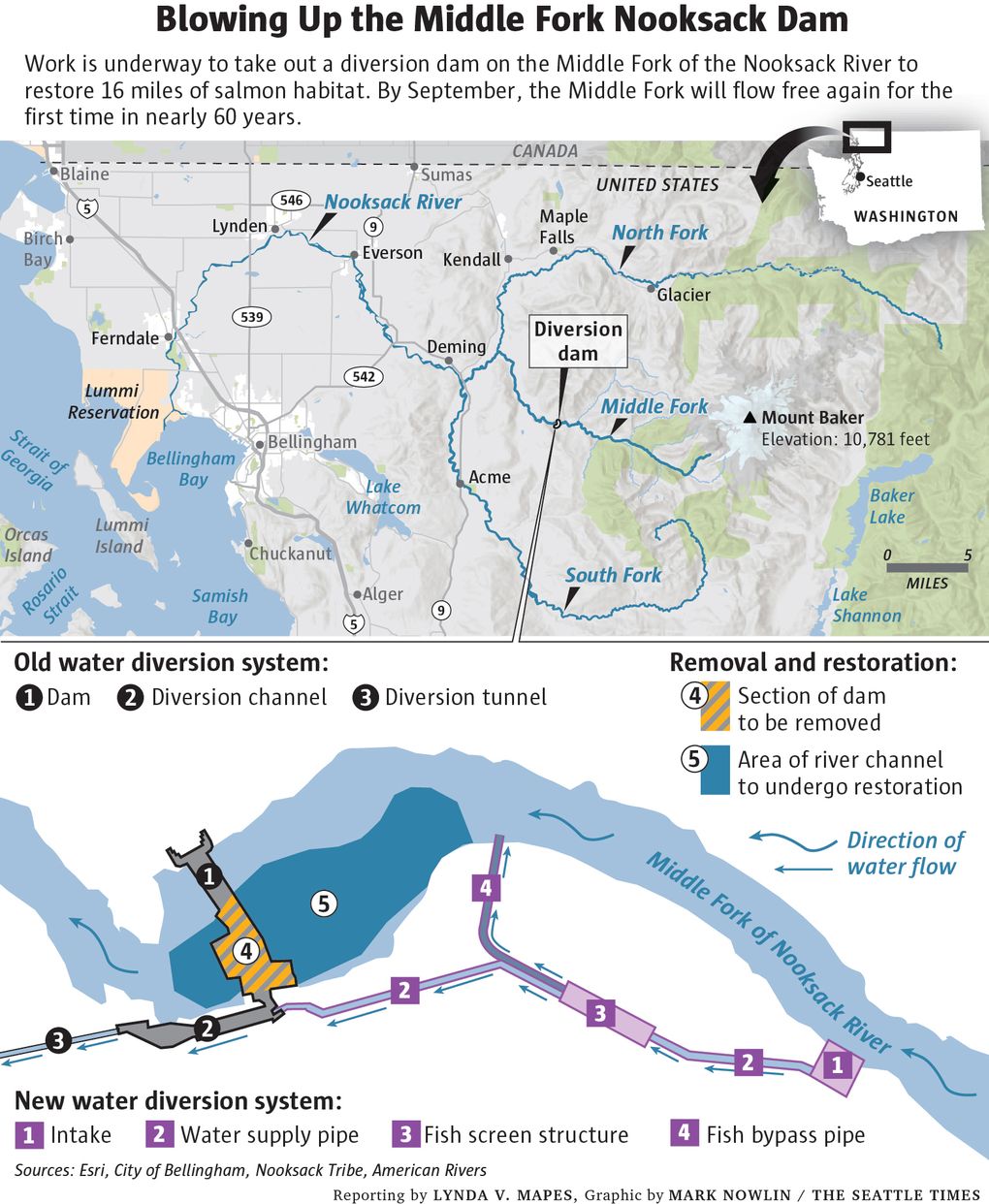
The Middle Fork Nooksack River Fish Passage project is one of several case studies that has been examined as a strategy for modifying the Robles Diversion Dam downstream of Matilija Dam.  Diversion dams can be particularly tricky as there is a need to not only pass the increased sediment expected with Matilija Dam removal, but also maintain water diversion and fish passage.  In the Nooksack case, this is accomplished by moving water diversion intakes upstream and completely removing the existing diversion dam. 

According to the City of Bellingham, the Nooksack River Fish Passage project will restore access to approximately 16 miles of pristine spawning and rearing habitat in the upper Middle Fork for three Endangered Species Act (ESA) listed Puget Sound fish species: spring Chinook salmon, Steelhead and Bull Trout. Project elements and related benefits include​ moving the point of diversion just upstream of the existing location to eliminate the need for the dam; dam removal and channel restoration to restore habitat connectivity; and installation of fully compliant fish screens for fish protection.


In the news:

Bang! Watch a Nooksack River dam finally coming down, freeing miles for fish habitat, Seattle Times, July 20, 2020


More information:

American Rivers: reimagining-a-river-the-middle-fork-nooksack

NOAA Fisheries: dam-removal-brings-hope-salmon-washingtons-middle-fork-nooksack-river

City of Bellingham: https://cob.org/services/environment/restoration/middlefork


On this blog: 

Watching the Dams Come Down- Elwha

Watching the dams come down - Elwha beaches

Watching the Dams Come Down - Condit

Savage Rapids Dam removed

Klamath Dam removal study supports sediment releases

San Clemente Dam removal

Monday, September 26, 2011

Watching the dams come down

The Elwha River restoration project can be viewed real time via a set of web cams.

http://www.video-monitoring.com/construction/olympic/js.htm


Here's the latest from today, just a week into the project:

Deconstruction of Glines Canyon Dam


Deconstruction of Elwha Dam


Graphics from the Seattle Times  


Tuesday, September 5, 2017

Matilija Dam news stories


Thanks to a $3.3 million grant from the California Department of Fish and Wildlife, the project will take a huge leap toward completion of the final design phase for removing the dam.

“What we’re seeing with dam removal is that a river will restore itself quicker than anyone predicted,” said Jenkin.
                                                                                                                   -  www.newsdeeply.com


The good news is coastal systems naturally recover quickly after a dam is removed.  But in order for recoveries like that to happen, old dams must be torn down and sediment must be dealt with. 
Matilija Dam would be a prime candidate. It provides no recreational value, no flood control and no water to the area. It has trapped 8 million cubic yards of sediment in its reservoir, and by 2020, it will be completely silted up.  It presents a major safety risk, and its owner, Ventura County, wants it gone. Patagonia, the outdoor gear maker, has thrown its considerable weight — and more than $275,000 — behind the removal effort. The river runs through the backyard of the company's headquarters.


...regarding "Managed Shoreline Retreat":

"The real aim is to give the beach room to adapt over the course of decades," he said. "In drought, we have a scarcity of sediment in the system and the beach naturally retreats. Then we have a flood cycle and the beach grows back again. Trying to hold that line interrupts the whole process."


And here's the latest on the Elwha dam removal project:

High Country News Sept 2017


Links:

https://www.newsdeeply.com/water/articles/2017/08/07/one-of-the-largest-dam-removals-in-california-history-inches-forward

https://www.eenews.net/stories/1060059083

http://www.hcn.org/issues/49.15/rivers-six-years-after-its-dams-came-down-a-river-is-reborn


Monday, January 23, 2012

Matilija Technical Advisory Committee


January 12-13, 2012 - Matilija Technical Advisory Committee meeting

The Matilija Technical Advisory Committee (TAC) met for two days to familiarize the members with the project and kick off discussions on moving forward with the next steps. (See Matilija Dam - Next Steps)

Matilija TAC field trip - Foster Park
The TAC was formed following the recommendations of last year's Fine Sediment Study Group Report. The goals are to:
(1) Assess key recommendations and major data gaps shown in the Fine Sediment Study Group’s Final Report (August 2011), and make any recommendations for additions.

(2)      Identify and prioritize a limited number of focused studies to address the key recommendations and major data gaps and develop a cost-effective scope of work and proposed budget for each study.

The two-day meeting included a field visit on day 1 and a meeting on day 2.  The field tour included stops at the Ventura River estuary and levee, Grant Park, Foster Park, Santa Ana Bridge, Hwy 150 bridge (Baldwin Rd),  OVLC Rice Rd Trailhead, Matilija Canyon, and Matilija Dam.  The day concluded with a short presentation of recent dam removals in the Pacific Northwest including the Marmot, Condit, and Elwha projects.  (See dam removal)

Matilija TAC field trip - Robles Diversion

Goals of Proposed Sediment Management Project:


1.      Restore effective fish passage, minimize impacts and restore aquatic/riparian/upland habitats in reservoir area
2.      Minimize cost/maximize cost-effectiveness
3.      Maximize mobilization of fine material to high flow events, minimize mobilization during low flows
4.      Minimize the impact of nutrients and turbidity in Casitas Reservoir as the result of the Project
5.      Not significantly increase water supply risk to customers of water districts
6.      Minimize permanent structures/artificial features within environmental sensitive areas such as the riparian corridor and upland habitats
7.      Minimize artificial or permanent stabilization material (i.e. riprap or soil cement) in reservoir area


The main goal of the TAC committee is to develop a Scope of Work for the following:

1. Hybrid Analysis: Assume that the dam removal notching and sediment excavation period is extended beyond a single year. Take advantage of natural sediment transporting flows. Reservoir sediment could still be dredged prior to each notch and placed either upstream of the dam or at the BRDA sites. The scope would include analysis of several different notching scenarios, upstream disposal, and downstream disposal scenarios to develop the most cost effective method of notching and sediment handling. Other components of the project could be a flow bypass around the reservoir area, a desilting basing, changing Robles operations, etc…

Matilija TAC - pondering the question
2. Interim Notching Analysis and Design: The dam would be notched to the silt level or slightly below the silt level. Detail the impacts associated with notching of the dam and develop a preliminary design. The same team that analyzes the interim notching could perform the hybrid analysis. Intensive monitoring would be part of the project so that the design of the remaining dam removal would be improved.
The breadth of the scopes should include:
• Develop detailed descriptions of the entire construction process, assuming the general phasing adopted by project management
• Identify significant unknowns and recommended studies to reduce the same
• Develop a cost estimate, identifying the estimated range of the unknowns on the costs
• Identify potential NEPA related-impacts


Matilija TAC - at the conclusion of Meeting 1
Followup from this meeting will ultimately lead to a Scope of Work for hiring a consultant team to conduct the investigations.

The TAC Members are:

Rick Bush, NOAA Fisheries 
Brian Cluer, NOAA Fisheries
Betty Courtney, DFG
Doug Chitwood, Corps of Engineers
Chris Dellith, NFWS
Tom Dunne, UC Santa Barbara
Blair Greimann, USBOR - Committee Chair
Tom Hepler, USBOR
Paul Jenkin, Matilija Coalition
Mary Larson, DFG
John Melack, UC Santa Barbara
Jeff Pratt, Ventura County WPD
Tim Randle, USBOR
Matt Stoecker, Stoecker Ecological
Jon Warrick, USGS
Steve Wickstrom, Casitas Water CMWD


..

Wednesday, April 29, 2020

Elwah steelhead success story


More good news from the Elwah River...  An article in Northwest Sportsman reveals the incredible resilience of the steelhead which have rebounded faster than predicted following the removal of two dams on the Elwah River in Washington State.  The video, "Rising from the Ashes" tells the story from the perspective of the dedicated biologists and volunteers who have undertaken annual snorkel surveys on the remote and hard to access river in the wilderness of the Olympic National Park.

The rapid recovery of the summer steelhead on the Elwah demonstrate the value of resident rainbow trout above dams.  Given the chance, even after 100 years with no possibility of returning from the ocean, these fish can make a comeback.

This is real world confirmation of the hope for recovering the endangered southern steelhead populations blocked by Matilija Dam.  With no human intervention, other than just getting out of the way, we can realize a rapid recovery of the native fish and the ecosystem on which we all rely.


New Film Highlights Elwha Summer-runs ‘Rising From The Ashes’, Northwest Sportsman, April 23, 2020

On this blog: steelhead