Showing posts with label EBM. Show all posts

Friday, December 1, 2023

Headwaters to Ocean (H2O) Conference

The California Shore and Beach Preservation Association (CSBPA) and Beach Erosion Authority for Clean Oceans and Nourishment (BEACON) organized the 2023 Headwaters to Ocean (H2O) Conference.  This was the first big in-person gathering of professionals involved in watershed and coastal  health, restoration, and management since the COVID pandemic.

On Tuesday November 28, BEACON convened their science advisory panel and stakeholders for a morning meeting followed by lunch and guided tour of the Surfers' Point Managed Shoreline Retreat Project.  

H2O was a two day conference held in the Crowne Plaza Hotel on Ventura Beach on November 29-30. 

The H2O conference serves as a catalyst for collaboration across various fields, industries, institutions, and organizations united by their shared interests in topics related to water, oceans, coastal environments, sediment management, resilience, and the intersections between terrestrial and marine systems.  

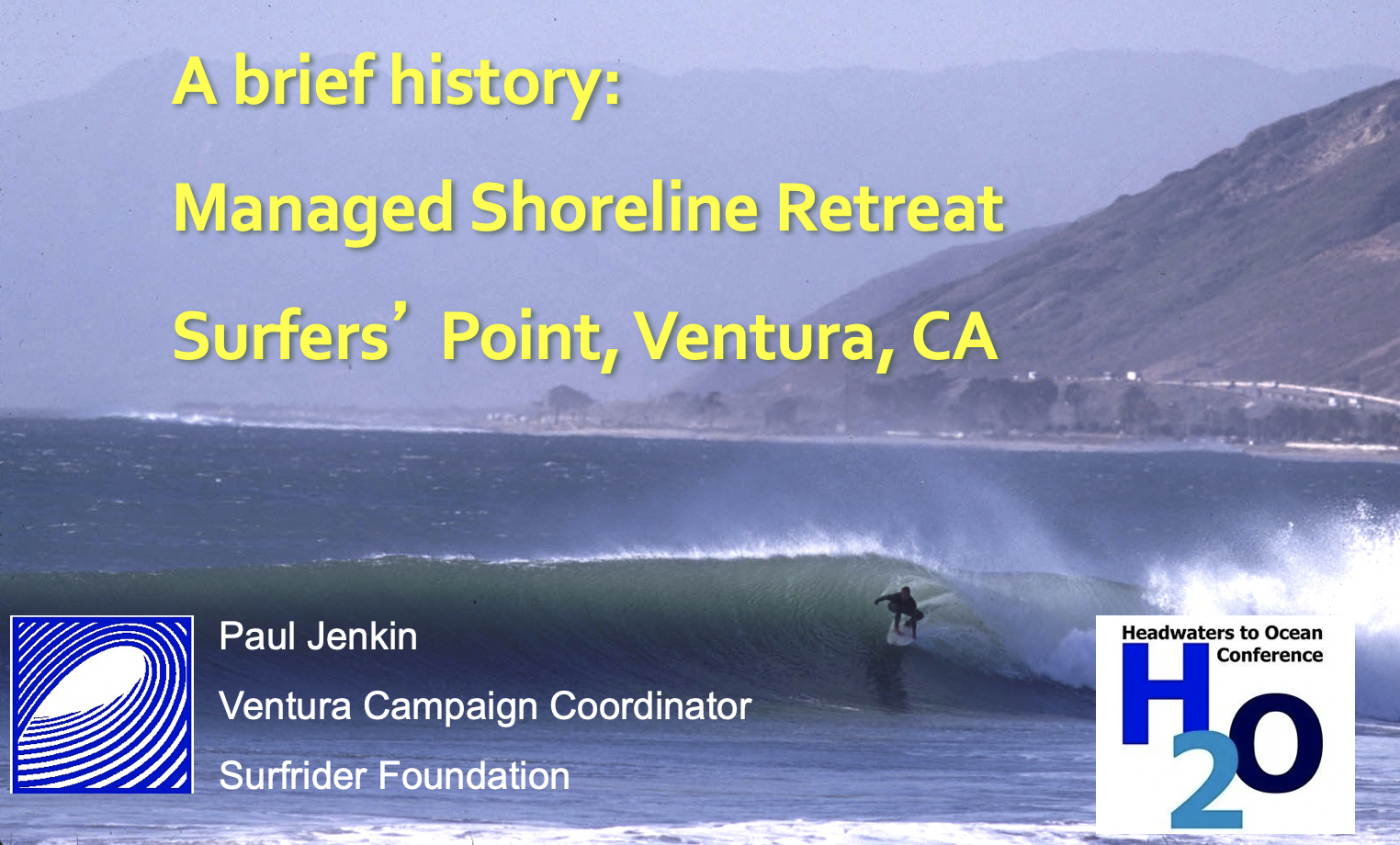
A session on Surfers' Point included presentations from Paul Jenkin, Surfrider Foundation, Bob Battalio, ESA, Dave Hubbard, CRC, and Kiki Patsch, CSUCI.  The talks covered the history, engineering, dunes, and monitoring.


Paul Jenkin presented the lunchtime plenary talk, "A Lifetime of Coastal Activism; A Retrospective" or "Headwaters 2 Ocean; Ventura River, a Case Study"


H2O Conference Website: https://asbpa.org/2023/08/15/h2o-2023-conference/


Tuesday, September 1, 2020

Economic Benefits of Dam Removal

An report published by the Bay Area Council Economic Institute outlines the economic benefits of the Matilija Dam Ecosystem Restoration Project.

from the website

... A valued forum for stakeholder engagement and a respected source of information and fact-based analysis, the Institute is a trusted partner and advisor to both business leaders and government officials. Through its economic and policy research and its many partnerships, the Institute addresses major factors impacting the competitiveness, economic development and quality of life of the region and the state, including infrastructure, globalization, science and technology, and health policy. 


An example of their analysis is summarized in the table below.  Note the multiple project components of the watershed-scale effort to remove Matilija Dam and restore the Ventura River ecosystem.


The full report may be downloaded here:  http://www.bayareaeconomy.org/report/job-stimulus-matilija-dam-removal/


Thursday, April 16, 2020

Ecosystem flows


Natural flows in rivers throughout the American West have been significantly disrupted by dams and diversions, groundwater extraction, land use changes, and other human influences.  Over time this has led to the decline of freshwater ecosystems to the point that many species have become endangered.  For instance, rivers rely on natural floods for maintenance of the river channel and floodplain, and flow of critical nutrients and biota.  Large dams mute or eliminate downstream flooding (winter flood pulses) by capturing these flows in a reservoir.  Similarly most western rivers are drying up during the dry months (summer/early fall base flows), an increasing concern with more frequent drought and heat due to climate change, and the primary concern on the Ventura River.

Functional Flows, figure from "A Path Forward for California's Fresh Water Ecosystems", PPIC 2019

The diagram shown here illustrates alterations to the natural flow regime throughout the year and a proposed "Functional flow regime."  The aim of functional flows is to re-establish some of the basic river functions in highly modified systems to restore ecosystem function.

The question is how to develop a management paradigm to allocate water to functional flows and ecosystem health?


A recent report by the Public Policy Institute of California presents the case for Ecosystem Based Management as a solution to California's water problems.  Maven's Notebook presents an excellent summary of recent discussions along with the technical references.


In particular, this report concludes that the current management focus on endangered species is failing, and we need a more holistic approach:

Ecosystem-based management emphasizes the simultaneous management of water, land, and species to improve ecosystem condition for native biodiversity and human uses. It shifts the management emphasis to the social, economic, and environmental benefits that come from healthy ecosystems, rather than narrowly focusing on mitigating harm to protected species.

Sustainable watershed management plans, backed by binding comprehensive agreements, are the best way to accomplish ecosystem-based management. These agreements can be adopted by state and federal regulators to meet Clean Water Act and ESA requirements and can align other agency priorities and actions.

With ecosystem-based management, there are a suite of actions available.  The first is to establish an ecosystem water budget that is an allocation of water for the environment that functions much like a senior water right that can store, trade, and flexibly allocate that water to respond to changing conditions.

An outline of this management approach is presented in the PPIC Policy Recommendations:

Promote inclusive planning and governance

  • Identify the desired ecosystem condition
  • Establish metrics
  • Provide strong scientific support
  • Set up transparent governance
  • Ensure reliable funding

Employ multiple ecosystem management tools
  • Establish ecosystem water budgets
  • Employ functional flows
  • Manage native and non-native species
  • Manage at the appropriate scale

Encourage sustainable watershed management plans
  • Align agency actions
  • Promote comprehensive agreements
  • Set timelines and backstops
  • Update water quality control plans
  • Incentivize or mandate plans

It is important to highlight the differences between ecosystem-based management and other, often similar approaches. For example, 

      * ecosystem management seeks to manage the ecosystem for species conservation goals and objectives, such as resilient populations of native plants and animals. This is accomplished principally by constraining land and water use and often uses recovery of protected species as a primary objective. In contrast, 

      * ecosystem-based management integrates human uses into the setting of conservation goals and objectives, balancing the uses of the resource. Ecosystem-based management also differs from 

      * Integrated Water Resources Management (IWRM), which focuses principally on coordination and funding of local water management projects while managing their impacts on ecosystems.


Renewed discussion of Ecosystem-based Management supports the vision presented in the Ventura River Ecosystem blog.  This approach applies readily to the Ventura River Watershed, especially with ongoing planning for this priority basin under SGMA.  The Sustainable Groundwater Management Act provides for self-organized groundwater sustainability agencies (GSAs) and required groundwater sustainability plans.  However, in our case the Ventura River would ideally combine the two existing GSA's into a single watershed-based agency to better realize the Ecosystem-based management approach.

On this blog:

Ventura River; Ecosystem-based Management

Reference:

text in italics above quoted from: 

Mavens Notebook: Ecosystem-based Management: A New Paradigm for Managing California's Freshwater Ecosystems

A Path Forward for California’s Freshwater Ecosystems, PPIC Water Policy Center, December 2019


More information:

TED GRANTHAM: THE EVOLUTION OF ENVIRONMENTAL FLOWS IN CALIFORNIA


Thursday, January 5, 2017

more #ResurrectTheRiver


Read more to learn more about Channelkeeper’s efforts to protect the Ventura River from over-pumping, and sign the petition to show your support:  RESTORING FLOWS IN THE RIVER

Friday, May 10, 2013

Sustainable Water Use in the Ventura River Watershed


On April 23, 2013 the Ventura River Watershed Council received a presentation from the UCSB/Bren School team on the results of their year-long Masters project titled 'Sustainable Water Use in the Ventura River Watershed.'

Bren project website http://www2.bren.ucsb.edu/~venturariver/

The project objectives are:


  1. Create a comprehensive watershed model
  2. Evaluate the effects of climate change and land use change on the water budget
  3. Identify actionable water resource management projects
  4. Propose a set of recommendations relevant to securing Proposition 84 funding, increasing water availability, and improving ecosystem function

The team based its analysis on a comprehensive water supply and demand model utilizing local data and the established WEAP software.  The model provides the opportunity to assess water management scenarios watershed-wide.  Development of this model was no small task given the complexity of our system with its multiple jurisdictions, water districts, and water users. Two graduate students worked as interns over the summer to compile data and 'connect the dots' between supply and demand throughout the watershed.  


Description of the Ventura River WEAP model

Once all the data was input, the model was validated by comparing modeled and measured stream flows and reservoir levels over the planning period.  From this a general water budget could be estimated. (note that this was based on the 'average' over the 1990-2009 planning period)

Water Budget from the Ventura River WEAP model

 Water management strategies were evaluated based on six criteria: ability to decrease demand, ability to increase supply, cost-effectiveness, benefits to ecosystem health, benefits to water quality, and suitability for Proposition 84 funding.  Results from the analysis suggest that, while climate and land use change have the potential to severely impact water availability within the watershed, implementing water resource management strategies can offset the impacts. 


Results for the Ocean Friendly Gardens scenario from the Ventura River WEAP model

Conclusions:

Consumer-based strategies such as ocean friendly gardens and greywater systems in single family homes were shown to be very cost-effective options for reducing water demand and increasing water supply, benefiting riparian ecosystem health. Although they are less cost-effective than consumer-based strategies, infrastructure-based solutions such as decentralized infiltration basins were shown to be viable pathways towards increasing water supplies and improving water quality. Results further suggest that the most effective option for decreasing demand within the watershed is by increasing water rates, thereby incentivizing conservation.


Recommendations:

  • Encourage widespread adoption of ocean friendly gardens and greywater systems
  • Implement a program to install a decentralized infiltration basins to capture stormwater runoff
  • Increase lowest water rates in the watershed to the state average


Two workshops have been scheduled (May 16 and May 23) to train watershed council members so that this model can continue to be developed and used in watershed planning efforts.  For more info contact Bill O'Brien: billo@ngeneng.com


References:
Bren Project:

On this blog:  http://www.venturariver.org/2012/05/ucsb-bren-school-project.html

Friday, August 31, 2012

Pumping and Diversion TMDL


One of the major issues currently facing the Ventura River is 'pumping and diversion'.  The river has been listed by the State Water Resources Control Board as 'impaired' in Reaches 3 and 4 due to excessive water diversion.  The water board is now considering developing a TMDL, or 'Total Maximum Daily Load', for this impairment.  The alternative is a MOA (Memorandum of Agreement) and plan of action for local water agencies to cooperate on a groundwater management plan.

Diversion of surface flows occurs at the Robles Diversion Dam (Reach 4) and at Foster Park (Reach 3) as well as smaller private diversions.  Pumping occurs at numerous wells that extract water from the shallow aquifers that are connected to surface flows.  In both cases, the amount of water flowing in the river is diminished, impairing ecological function.  For example, low flows become a problem when combined with excessive algae growth - this reduces dissolved oxygen levels that aquatic life depends upon.  (See Algae: problem or symptom?)

Pumping water from wells during dry summer months may cause pools to rapidly dry up, stranding and killing native steelhead trout and other aquatic species.  Although this often goes unseen (they become fodder for predators such as herons, racoons, etc.), fisheries managers in past years have responded by relocated fish from drying pools.

Pumping and Diversion has been discussed during several of the recent watershed council meetings, along with presentations about water rights and the effects of wells on surface flows.  As one would expect, there is controversy surrounding the cause and effect, and some even question if there is reason for the impairment listing.

In order to illustrate the problem, Santa Barbara ChannelKeeper produced this video:


The timelapse sequence in this video and the pressure logger illustrate the rapid filling and drying of a pool on the Ventura River Preserve.  Because this occurs independently of time of day it suggests that something other than natural evapotranspiration is occurring to impact surface flows in the river.

To illustrate the issue, local groundwater professional Jordan Kear has provided presentations to the Watershed Council. These graphics are from Surface & Groundwater Interaction Study, Kear 7-17-12

The main stem of the Ventura River is divided into two groundwater basins, with the division occurring at Foster Park.

To understand what happens to surface flow, one must understand how the stream interacts with groundwater.  A stream may be 'gaining' or 'losing' depending upon the level of the water table beneath and adjacent to the river channel.  And when the water table drops far enough the stream becomes 'disconnected.' 


One of the areas in question is Reach 4, the section of river downstream of the Robles Diversion  within the upper Ventura River groundwater basin.  As the figure below illustrates, this 'Robles Reach' is usually a 'losing stream,' which often becomes 'disconnected' in dry periods. 


Then, as river flows increase during winter months and the groundwater basin fills back up, and surface flows re-establish.  (In extremely wet periods it may also become a 'gaining stream')

Surface water (dotted line) and Groundwater (solid blue line) interaction
 in the Robles Reach of the Ventura River  (Kear Groundwater)

Although this Surface & Groundwater Interaction Study concluded that "pumping of wells has a relatively minor effect on river flow," this was based upon an experiment that revealed the Meiners Oaks Water District wells reduced river flows by up to 1.5 cfs (cubic feet per second.)  However, this conclusion does not take into account the cumulative effects of multiple wells pumping from the same groundwater basin when summer inflows from Matilija Creek may only be 5-10 cfs or less.

 Reach 4 - Wells within 1000 ft of Ventura River

What this study does demonstrate is that there is some direct interaction between groundwater pumping and surface flows.  What is less clear is the effect from wells farther from the river, but within the larger Upper Ventura River groundwater basin.

Wells within the Upper and Lower Ventura groundwater basins


Last year, a first cut at developing a water budget for the two groundwater basins was presented with the Upper and Lower Ventura River Basin Groundwater Budget.  (The first draft of this analysis suggested an overdraft of 3,240 acre-feet per year, before Lake Casitas storage/supply was added.)

Reach 3 is under similar stress, as the City of Ventura has recently constructed new wells at Foster Park.  Although these wells are regulated by NOAA Fisheries, who have established minimum flow criteria, this reach is influenced by other extractions which have cumulative effects on surface flows.

Although this is clearly a difficult issue, the TMDL listing has brought many of the major water suppliers and users together to potentially work cooperatively on a groundwater management plan.


It is important to understand that this is not only about endangered species and recreation, which are protected under the Clean Water Act, but most importantly the future sustainability of our communities, including over 100,000 residents in Ojai and Ventura:
  • Our communities depend almost entirely on the Ventura River for water supply
  • In recent years, expansion of agriculture as well as planned urban development are increasing pressure on this limited resource
  • New wells are being constructed, increasing groundwater pumping
  • Currently there is no coordinated oversight of groundwater resources on the main stem of the Ventura River
  • We are clearly at, or above, the maximum sustainable water extraction from the Ventura River

More info:

Pumping and Diversion Fact Sheet

A Really Short Course on Water Rights, Birosik 6-13-12

Surface & Groundwater Interaction Study, Kear 7-17-12 (2.8 Mb)

Upper and Lower VRB GW Budget and Management Presentation 05-25-2010 (3.4 Mb)

Upper and Lower Ventura River Basin Groundwater Budget and Management Plan (18 Mb)


See also:

http://www.venturariver.org/search/label/groundwater

http://venturawatershed.org/presentations

http://friendsofventurariver.org/document/?cat=Ground%20Water

http://venturawatershed.org/past-meetings


...
Monday, August 6, 2012

West Coast EBM Network video


New video profiles several of the projects within the West Coast Ecosystem-based Management Network.

Thursday, May 10, 2012

UCSB Bren School project


The Watershed Council meeting this week included a presentation on a recently initiated project to develop a water budget for the Ventura River watershed by a team from the UCSB Bren School of Environmental Science & Management:


Sustainable Water Use in the Ventura River Watershed

A group of six graduate students from the Bren School of Environmental Science and Management at the University of California Santa Barbara has initiated a year-long master’s thesis on sustainable water use in the Ventura River watershed. The team plans on taking an interdisciplinary approach towards identifying opportunities for economically and environmentally beneficial water management strategies within the watershed. In order to meet these goals the group plans to create a comprehensive water budget for the Ventura River watershed utilizing the WEAP (Water Evaluation and Planning System) Model. This water budget will combine data from existing groundwater and surface water models with economic analysis for use in evaluating different water management scenarios.

The WEAP Model (www.weap21.org) is a software tool that assists resource planners with integrated water management. It has been used successfully to evaluate water quality and quantity issues worldwide, at a variety of scales, by a number of agencies and planners.


Once the model is set up, it can be used to evaluate the effects of changes in climate, water use, and management practices such as:

Reusing urban greywater for irrigation and other non-potable uses in order to increase water-use efficiency.

Installing decentralized wastewater treatment plants (WWTPs) in Ojai to decrease energy costs associated with water transport.

Implementing stormwater BMPs to improve water quality and to help achieve TMDLs for algae.

Using the WEAP Model, the team intends to identify easily-implementable projects which may result in significant savings in water, energy, and money throughout the watershed.

Improving the understanding of the water-budget by clearly mapping out the complex interconnections between various water uses and sources within the watershed is a necessary step towards integrated watershed management.

The team intends to create a tool that will be useful for water users and resource planners within the Ventura River watershed. In order to achieve this, it is critical that suggestions, comments, and criticisms from the community be considered at every step.

Please do not hesitate to contact the project team via email at: VenturaRiver@lists.bren.ucsb.edu

The team members are: Ryan Gardner, Naheed Iqbal, Austin Love, Brenda Ponton, Jake Sahl, Dan Yocum.  The Faculty Sponsor is Dr. Arturo Keller, Professor, School of Environmental Science and Management University of California Santa Barbara


More on the current Bren School Projects here:  http://www.bren.ucsb.edu/research/current_gp.htm


...

Tuesday, November 22, 2011

Why is the ocean brown?

Every time it rains, runoff from the land impacts the river and coast.  And although we have accepted the 'chocolate milk' surf as normal after it rains, it has not always been this way.  This is what is known as a 'Shifting Baseline.'  (See Shifting Baselines in the Surf)


Rainfall this weekend was equivalent to what is known as the 'design storm' - we received approximately one inch over a 12 hour period.  For regulatory and engineering purposes, this quantity of rainfall can and should be retained on site.  This requirement is in the Ventura Countywide 'MS4'  (Municipal Separate Storm Sewer System) Permit, as a standard that all new development will be held to.

The problem, however, is that over the past 100 years our development patterns have directed rainfall off the land, into storm drains, and directly into the river and ocean.

URBAN RUNOFF:

Here's what Ventura Avenue looked like during the rain: the parking shoulder was flowing like a creek.  This is an example of Urban Runoff, and the water here is carrying everything from 'dog poop' and trash, to brake fluid and pesticides, into the storm drains and out to sea.


INDUSTRIAL RUNOFF:

A little further up the Avenue are the oil fields.  Here the runoff changes to a muddy brown.  Here erosion of soil from miles of oilfield roads in the hills and large impervious work yards flushes into the street...


...into the storm drains, and out to the ocean.  Any chemicals that have spilled or absorbed into the ground are flushed off the land along with this soil.


Santa Barbara ChannelKeeper Stream Team volunteers have been sampling this site for a couple of years, and although oil and gas is generally exempt from clean water rules, Santa Barbara ChannelKeeper has been successful in forcing Aera Energy to enroll in the industrial stormwater permit program.  


This video, starting around 3:20, describes ChannelKeeper's work and illustrates the runoff from this area, and also shows how security guards harass watchdogs, even though this is a public street.  


AGRICULTURAL RUNOFF: 

As the video illustrates, another major source of pollution agriculture.  Both livestock and irrigated crops contribute to water quality problems.  

One area we have been watching is the recent expansion of orchards and row crops at Taylor Ranch on the west side of the Ventura River.  This strawberry field was sprayed with chemicals on Friday, despite the storm bearing down on the region.  Because conventional strawberry growers use plastic to cover the ground, these fields generate significant runoff when it rains. 


Here a Santa Barbara ChannelKeeper volunteer is collecting a water sample from under the Main St bridge, just downstream of these fields.    Note the color of the river water. This sample will be analyzed for pesticides...  although a full-suite analysis would likely turn up a variety of pollutants.


Under the bridge is one of dozens of campsites in the floodplain - another issue of concern documented here: Salmon Run focuses on trash issue


We also went to look at the runoff onto Emma Wood State Beach from the strawberry fields up on the hill at Taylor Ranch.  This is a problem we first documented in 2007  when the fields were first developed.  We continue to received numerous reports from beach users, and this photo confirms that runoff still directly enters the ocean from these fields every time it rains.


The combination of all these sources, known as 'Non-Point Source Pollution' has a significant impact on our coastal water quality and health of the ecosystem.  The fine sediments that enter the river and ocean linger for months, and this is why the water at Surfers' Point often appears muddy, long after the rains have stopped.


This diagram summarizes the issues outlined here.  This is just a small part of the big picture...


...


Thursday, September 29, 2011

West Coast EBM Network meeting


This year's annual meeting of the West Coast Ecosystem-based Management Network drew experts from around the region.  First the founding member projects provided an overview and update of their projects:

Humboldt Bay Initiative
     Susan Schlosser, CA Sea Grant Becky Price-Hall, City of Trinidad
Port Orford Ocean Resource Team (POORT)
     Leesa Cobb, POORT Exec. Director
Elkhorn Slough Tidal Wetland Project
     Bryan Largay, TWP Director
San Luis Obispo Science and Ecosystem Alliance (SLOSEA) 
      Dean Wendt, Ph.D., Melissa Locke, SLOSEA Policy & Communications Mgr.
Ventura River Ecosystem Project
    Paul Jenkin, Surfrider Foundation – Ventura Chapter

The network then heard from several other projects that are applying 'ecosystem-based management' approaches to their local initiatives:

Hood Canal Coordinating Council
    Scott Brewer, HCCC Exec. Director Jacques White, Ph.D., Long Live the Kings
Washington State Outer Coast Marine Resource Committees
    Pete Stauffer, Surfrider Foundation
Santa Monica Bay Restoration Commission
    Lia Protopapadakis, SMBRC Tom Ford, SMBRC
San Diego Fishermen’s Working Group
    Pete Halmay, Working Group President Kristen Goodrich, Tijuana River NERR
Point Reyes Bird Observatory (PRBO)
    Applied California Current Ecosystem Studies ACCESS Project
    Meredith Elliot, PRBO Dan Robinette, PRBO


Information about national-level and West Coast regional developments was presented. Topics  included the new National Ocean Council, planning for a West Coast Regional Planning Body and Coastal and Marine Spatial Planning, and the West Coast Governors’ Agreement on Ocean Health (WCGA), with a focus on linking these activities to local-level efforts. Detailed discussion  also centered on the activities of the new WCGA Sea Grant Fellows, and opportunities for overlap with Network and partner efforts.


The afternoon fieldtrip to the marshlands of Humboldt Bay provided an opportunity to learn about the City of Arcata's unique wetlands wastewater treatment system.   

This year's meeting drew a large number of participants with plenty of opportunity for information sharing and networking.


Monday, May 23, 2011

Towards Ecosystem-based Management

This is the presentation from the Ventura Hillsides Conservancy annual meeting. 'Towards Ecosystem-based Management' outlines the issues facing the community, and current and ongoing efforts towards integrated watershed management to benefit our coastal resources:


on Youtube here

A similar presentation with a fish-centric message was part of the plenary session for the annual Salmonid Restoration Federation conference in March. The same message will also be presented this week in San Diego at the Headwaters to Ocean (H2O) Conference.

Thanks to Robert Barrett who recorded and edited this presentation and broadcasts our materials on CAPS TV in Ventura. Many of these shows are also online at the Surf and River Report

Thursday, October 28, 2010

West Coast EBM 2010


This week the West Coast EBM Network held its annual meeting. This year the meeting was held in Monterrey, CA, selected for its proximity to the Elkhorn Slough, the site of one of the West Coast projects.

Part of the meeting was dedicated to getting updates from the various projects, and strategizing next steps for the network.

We also received presentations on the following:

  • EBM Tools and Training
  • NOAA National and Regional Developments Update
  • National Ocean Policy Update
  • WCGA Update
  • West Coast Integrated Ecosystem Assessments (IEAs)
  • COMPASS
  • Monterey Bay National Marine Sanctuary
  • Green Fire Productions Ocean Film
  • Surfrider Foundation
I took the opportunity to share the trailer for our 'Cycle of Insanity' film, which provides the 'big picture' of our misuse of fresh water resources and how we can fix the problem through 'Integrated Management' - or 'Ecosystem Based Management (EBM)' - which is basically the goal of Surfrider's Know Your H2O program.


We were also treated to a field tour of Elkhorn Slough by program managers Bryan Largay and Monique Fountain. Kayaks are the preferred vehicle for navigating the slough and observing wildlife - and we saw sea otters, sea lions, seals, pelicans, and plenty of shorebirds.

Bryan provided an overview of the problems facing the slough since the Army Corps constructed Moss Landing Harbor. The large entrance to the ocean greatly increased tidal currents in the slough. These currents subsequently caused erosion of the channels and banks, with loss of sediment out to the ocean. The changed hydrology resulted in changes in habitats, with the major loss of tidal salt marsh which makes up the foundation for this ecosystem.

The project is about to break ground on construction of a small 'sill,' or submerged weir in the back channels of the slough. The Parsons Slough Restoration Project is intended to begin a process to restore the historic tidal hydrology within the slough.

More info:

www.westcoastebm.org

Elkhorn Slough Tidal Wetland Project

Know Your H2O

Tuesday, September 14, 2010

California and the World Ocean Conference


On Wednesday September 8, 2010, our West Coast Ecosystem-based Management Network presented at the California and the World Ocean conference in San Francisco. This is the fourth such conference since 1997, intended to "bring together representatives from government, academia, industry, and the public to share ideas and formulate action strategies for the 21st century." Indeed, the conference was a 'who's who' of coastal and ocean policy, with hundreds of attendees from every sector working on ocean issues.

I have attended all of these conferences, and published Managed Shoreline Retreat and Dam Removal: Ecosystem Restoration to Benefit Coastal Resources at CWO '02.


Real Steps to Ecosystem Management on the West Coast

Moderator: John Hansen, Coordinator, West Coast EBM Network
Leesa Cobb, Executive Director, Port Orford Ocean Resource Team
Mark Wheetley, Senior Biologist Specialist, California Department of Fish & Game
Bryan Largay, Tidal Wetland Project Director, Elkhorn Slough National Estuarine Research Reserve
Dean Wendt, Executive Director, San Luis Obispo Science and Ecosystem Alliance, Center for Coastal Marine Sciences, Cal Poly State University
Paul Jenkin, Ventura Campaign Coordinator, Surfrider Foundation

At California and the World Ocean 2010, the West Coast Ecosystem-Based Management Network will deliver a robust and timely update summarizing the latest advancements of ecosystem management in California and along the West Coast. Network members will spotlight their local ecosystem based management (EBM) activities, as well as the benefits
of their unique coast-wide partnership. The panel session will also draw distinct parallels to the latest developments in national ocean policy, regional ocean governance and the West Coast Governors’ Agreement on Ocean Health.

Tuesday, April 20, 2010

The good, the bad and the ugly

Earth Day update in this week's VCReporter:


'Experts weigh in on the state of the environment in Ventura County'


The Good: “The good news is that we are on the verge of breaking ground on a Surfer’s Point restoration project,” he said. “It’s taken almost 20 years to get to this point. That’s a huge positive, and something to look forward to this year. The plan is to restore the beach at the mouth of the Ventura River in response to the damage that occurred almost 20 years ago with the bike path and parking lot, and to restore the beach. It’s at the mouth of the river, so the beach comes and goes depending on how wet a year we have, but this is a progressive solution. We are restoring the natural buffer zone.”

The Bad: “The process to remove Matilija Dam has run into major stumbling blocks, where many of the stakeholders have been left out of the decision-making process,” he said. “The current proposal to build a gigantic wall to retain the sediment in perpetuity behind the dam is contrary to the vision of many who have looked forward to the restoration of that watershed.”

The Ugly: “A recent river clean up by the Main Street Bridge near the Ventura River estuary netted over five and a half tons of debris. A similar clean-up last fall netted even more. This is the result of large populations of people living in the river bottom. I think this is a real sign of our society and its neglectful inability to address social problems has environmental ramifications.”

Saturday, October 24, 2009

Port Orford EBM Conference


West Coast EBM Network 2nd Annual Meeting was held October 21‐23, 2009 in Port Orford, Oregon.

The primary objectives of the meeting were to learn about the Port Orford project in depth and share ideas and opportunities on emerging issues.

Port Orford is one of six community-based initiatives focused on the successful implementation of ecosystem-based management (EBM) along the coasts of Washington, Oregon and California. The Network was formally organized in 2008 (visit the website to learn more about the other projects, including Ventura.)

Having the opportunity to visit these sites and meet the people involved in these community efforts is always interesting. In Port Orford, their effort has resulted in the Port Orford Ocean Resource Team (POORT.)

POORT aims to protect their historic fishing grounds through integrated management of a Community Stewardship Area. The knowledge of the local fishermen was used to identify the marine portion of the ecosystem that were most relevant to the management goals. However, POORT also recognized the necessity to include the upland watershed terrestrial portions of their ecosystem that impact the marine portion and associated nearshore fisheries. As a result, their ecosystem planning area also includes roughly ¼ land area and ¾ ocean area.

The specific boundaries of the Community Stewardship Area were based on input gathered at public meetings and workshops in Port Orford. The primary considerations were socioeconomic (e.g., historic fishing grounds) and political (e.g., north and south boundaries are halfway between adjacent ports).

The Port Orford Community Stewardship Area is biologically diverse and encompasses terrestrial, freshwater, intertidal, and ocean environments. The Community Stewardship Area is 1,320 square miles, and includes 385 square
miles of terrestrial habitat and 935 square miles of ocean habitat. The area is 30 miles long (north to south), extends 18 miles offshore (west), and encompasses the Elk and Sixes River watersheds.

Tuesday, June 2, 2009

West Coast EBM Network


Surfrider Foundation is collaborating with the NOAA Coastal Services Center and many other partners to advance local approaches to ecosystem-based management (EBM).

The West Coast EBM Network is a partnership of six community-based initiatives focused on the successful implementation of ecosystem-based management (EBM) along the coasts of Washington, Oregon and California. Priorities of the network include: shared learning between the six projects; identification of “best practices” for community EBM; and building political support for implementation.

The Surfrider Foundation has formal involvement in three of the six projects including; Ventura, CA; Port Orford, OR; and San Juan County, WA. We look forward to sharing outcomes from the effort with other Surfrider chapters around the globe. For more information on the network, check out the new website.

Monday, February 23, 2009

What is EBM?

Wednesday, February 11, 2009

Code Green: Hot, Flat, and Crowded


There is a growing opportunity as more and more local groups begin to form around climate change. In the Ventura bioregion we have seen the Ojai Green Coalition and VCCool generate a renewed interest in local activism. Even the kids are getting organized.

Aligning all this energy, and getting these latent activists up to speed is the first challenge. The next is finding ways to put EVERYONE to work on solving the looming crisis, which is actually the convergence of several crises all at once.

Thomas Freidman outlines a strategy in his bestseller, "Hot Flat and Crowded." He calls it "Code Green," or 'Why We Need a Green Revolution--and How It Can Renew America'


Thomas L. Friedman’s phenomenal number-one bestseller The World Is Flat has helped millions of readers to see the world in a new way. In his brilliant, essential new book, Friedman takes a fresh and provocative look at two of the biggest challenges we face today: America’s surprising loss of focus and national purpose since 9/11; and the global environmental crisis, which is affecting everything from food to fuel to forests. In this groundbreaking account of where we stand now, he shows us how the solutions to these two big problems are linked--how we can restore the world and revive America at the same time.

Friedman explains how global warming, rapidly growing populations, and the astonishing expansion of the world’s middle class through globalization have produced a planet that is “hot, flat, and crowded.” Already the earth is being affected in ways that threaten to make it dangerously unstable. In just a few years, it will be too late to fix things--unless the United States steps up now and takes the lead in a worldwide effort to replace our wasteful, inefficient energy practices with a strategy for clean energy, energy efficiency, and conservation that Friedman calls Code Green.

This is a great challenge, Friedman explains, but also a great opportunity, and one that America cannot afford to miss. Not only is American leadership the key to the healing of the earth; it is also our best strategy for the renewal of America.

Tuesday, February 3, 2009

Water supply and drought

According to an article in the Ojai Valley News, the current drought and new water pricing is creating tension between water agencies and farmers. When wells run dry, growers have become accustomed to subsidized water imported from Lake Casitas. But with rate increases intended to cover the true cost of water, a local water district is reaching economic limits.

“The Senior Canyon board states that agriculture is no longer a viable aspect of our environment,” the rebuttal letter said. “We believe this statement is wrong. Agriculture is an integral part of life in Ojai’s East End … If the choice needs to be made between preserving agriculture in the East End and preserving the water company known as Senior Canyon, we choose to preserve agriculture.”


Lack of integrated management between multiple water districts, municipalities, private well owners, and public agencies has resulted in over-allocation of the limited ground water basins and ongoing conflicts over current and future water use.

And as the creeks dry up, ecosystem function is impaired by diminished surface flows and degraded water quality.


Meanwhile, the statewide drought continues to worsen. The Central Valley Project, which provides irrigation water to central valley farmers, may have ZERO water this year. And water rationing is being considered for the majority of Ventura County which relies on imports from the State Water Project.

This is not just a local trend. A recent headline states: Australia faces collapse as climate change kicks in