Showing posts with label Ecosystem. Show all posts

Wednesday, October 2, 2024

Historic Ecology: Oak Trees

One of the biggest changes to the Ventura River ecosystem came with the influx of settlers in the 1800s.  Some say the oak woodland that filled the valley was so dense that a squirrel could travel in the canopy from Ojai to the beach in Ventura without touching the ground.  But as people moved in, land was cleared to make room for agriculture with the wood exported to the growing city of Los Angeles, much of it to be burned as firewood. 

As the oak woodland was replaced with irrigated agriculture the water balance shifted from abundance to deficit.  Rather than capturing and infiltrating rainfall, the land now required that water be pumped from the aquifers to sustain crops and orchards.  By 1890, over 4,000 acres had already been deforested.  Today there is approximately 6,000 acres of irrigated land in the Ojai Valley.  

Recognizing the importance of maintaining and restoring the remaining oak woodlands, the County of Ventura and other jurisdictions throughout California have ordinances protecting oak trees.  Many organizations work to educate residents and coordinate volunteer efforts.  In the Ojai Valley this includes;

Once upon a Watershed celebrates OAKTOBER, Oak Awareness Month. 

Join OUW and other organizations and individuals across the state and country as we recognize the importance of oaks and oak ecosystems.  Every individual, organization, and community can play an important role in celebrating oaks and oak ecosystems throughout the month of October—OAKtober!

OAKtober_376U.jpg


Ojai Trees is an Ojai Valley community forestry group that welcomes people of all ages and backgrounds who want to do something tangible to help the environment. 


The following are excerpts from publications documenting the history of oaks in California:

Meiners Oaks

http://ojaihistory.com/he-got-meiners-o-for-unpaid-debt/

John Meiners, native of Germany, had come to the United States about 1848 and had established a successful brewery business in Milwaukee. He acquired this Ojai ranch in the seventies, sight unseen, as a result of an unpaid debt. When he heard that his friend, Edward D. Holton, a Milwaukee banker, was going to California for a brief trip, Meiners asked him to see the property he had acquired. Mr. Holton’s evaluation was perhaps it was the largest oak grove on level land in Southern California, much of it so dense that the ground was in continuous shade. Furthermore, to his surprise, Meiners discovered that the climate of the valley was good for his asthma.

The barn and livestock area on the Meiners Ranch. A fence surrounds the main oak grove seen in the distance.
The barn and livestock area on the Meiners Ranch.
A fence surrounds the main oak grove seen in the distance.
Ojai Valley Museum

Oaks of Southern California

https://www.kcet.org/shows/lost-la/the-oak-trees-of-southern-california-a-brief-history

When Europeans arrived, they noticed the beauty of the oaks and used them as a way to make sense of their novel surroundings. Upon summiting the Sepulveda Pass and looking out over the San Fernando Valley in 1770, a Spanish expedition called the expansive plain Valle de Santa Catalina de Bononia de los Encinos. ("Encino" is Spanish for live oak.) In central California, a later expedition named a oak-shrouded pass El Paso de Robles. ("Robles" referred to the area's valley oaks.) Later, as highly visible landmarks, some trees served as boundary markers between ranchos, appearing on diseƱos that recorded Spanish- and Mexican-era land grants.

But almost as soon as the Spanish enshrined the oaks in the region's place names, the more intensive uses of they land they introduced began to threaten the trees' survival. Farming, annual husbandry, and the arrival of non-native annual grasses stymied oak reproduction. Mature oaks were cut for lumber or fuel.

American land use practices only intensified the destructive processes. Like their Spanish predecessors, Americans would name their communities and streets after the trees (Thousand Oaks, Fair Oaks Boulevard, etc.) and then proceed to hasten their downfall. Because of the irregular shape of their trunks, oak trees were rarely felled for lumber, but oakwood came to be prized as fuel. The dense wood and lack of resin meant that the wood and resulting coals burned long and slowly.

Just as they had sustained Southern California's indigenous peoples, oak trees nourished residents of the booming city of Los Angeles, albeit in an indirect and unsustainable way. Demand in Los Angeles for hardwood drew loggers into the San Fernando, Santa Clarita, and San Gabriel valleys. As the loggers clear-cut thousands of acres of oak woodlands and savannas and delivered the firewood to Los Angeles, bakers tossed the wood into their ovens, feeding a city while denuding the countryside.

Oaks also fell to the axe as Southern Californians envisioned more profitable uses for oak-dominated landscapes. In the nineteenth century, citrus growers cleared oaks savannas to make way for orchards. Other oak habitats declined as groundwater pumping lowered the water table. Later, real-estate developers uprooted trees to build new houses and commercial properties for the expanding metropolis.


A Brief History and Guide to California's Native Oaks

http://www.ourcityforest.org/blog/2020/7/a-brief-history-and-guide-to-californias-native-oaks

The native oaks of California once dominated the landscape. Accounts of Spanish explorers mention their awe at the sight of the abundance of oaks around them. However, those with the strongest connection to the oaks of California were and are indigenous people.

Unfortunately, the arrival of the Spanish did not bode well for the native people nor the oaks of California. The Spanish introduced grazing animals and felled oak forests to make room for their agricultural enterprises. They also saw value in the lumber of oak trees, leading to even more deforestation. Before the native people could do anything to prevent them, the Spanish had dramatically damaged the relationship between the people and the oaks. 

The people native to Santa Clara Valley are known as the Ohlone, which is a name that encompasses 50 separate tribes ranging from the South Bay all the way down to Monterey. Native oaks of California are ingrained in their society as a resource both physically and spiritually. Acorns were the primary food source for the Ohlone prior to the arrival of the Spanish and were held in high regard amongst the native people. Anthropologists estimate 75% of native Californians relied on acorns in their daily diet. Their new year, a joyous occasion, was marked by the acorn harvest. The Ohlone people would dance amongst the oak groves each year to promote a good harvest. During the acorn harvest, entire families would go out and collect the acorns of a large tree, which took about a day. The women would then prepare the acorns by shelling them and using a mortar and pestle, grinding the acorns into a fine powder. After being ground, the acorn flour would undergo the lengthy process of leaching the bitter tannins from the acorns which made them unpalatable. After the tannins were leached, the acorn flour was much sweeter and easier to eat and could be used to make soups, mush, and even bread (I myself love acorn bread). Excess unground, shelled acorns could be stored up to 10 years. The preparation of acorns was not just fulfilling a necessity. It was also a time for social connection during which the women could talk amongst themselves and share stories of their lives and even gossip. 


The Powerful Survival Story of California’s Oaks

https://marinmagazine.com/feature-story/oak-stories/

The story that oaks tell about the impact of humans in California is mostly a sad one. Natural landscapes dominated by oak trees once covered more than a third of the state. Starting around 1850, clearing trees for agriculture and grazing decimated vast oak lands, and a century later the subdivision boom inflamed a trend that has never really ceased. Biologists now estimate that more than a third of California’s original 10 to 12 million acres of oak woodlands have been lost since settlement, and only about 4 percent of the remaining woodlands are protected. When oaks are lost, so are many of the wild creatures and other plant life that are part of the oak’s rich natural web — among the most biodiverse of the state’s ecosystems.


ACORNS: TRADITIONAL FOOD STAPLE

http://www.danielnpaul.com/CaliforniaNativeAmericans-Acorns.html

As late as 1844, when explorer John C. Fremont led an expedition to the Sacramento Valley, he described the north state foothills as "smooth and grassy; [the woodlands] had no undergrowth; and in the open valleys of riverlets, or around spring heads, the low groves of oak give the appearance of orchards in an old cultivated country." Similarly, a nineteenth-century visitor to the middle fork of the Tuolumne River near Yosemite Valley found it "like an English park-a lovely valley, wide and grassy, broken with clumps of oak and cedar."

Fires were used to insure good growth and healthy orchards:

Natives may have been setting fires for 5,000 years speculates Kat Anderson (an ethnobotanist with the Amerindian Studies Centre at UCLA), judging by how long fire-loving giant sequoias have been expanding their range.


The History of Oak Woodlands in California, Part II: The Native American and Historic Period

https://scholarworks.calstate.edu/downloads/sn00b2449

The open oak woodlands described in the accounts of Spanish explorers were in large part created by land use practices of the California Indians, particularly burning. Extensive ethnographic evidence documents widespread use of fire by indigenous people to manipulate plants utilized for food, basketry, tools, clothing, and other uses. Fire helped maintain oak woodlands and reduce expansion of conifers where these forest types overlapped.


Friday, December 1, 2023

Headwaters to Ocean (H2O) Conference

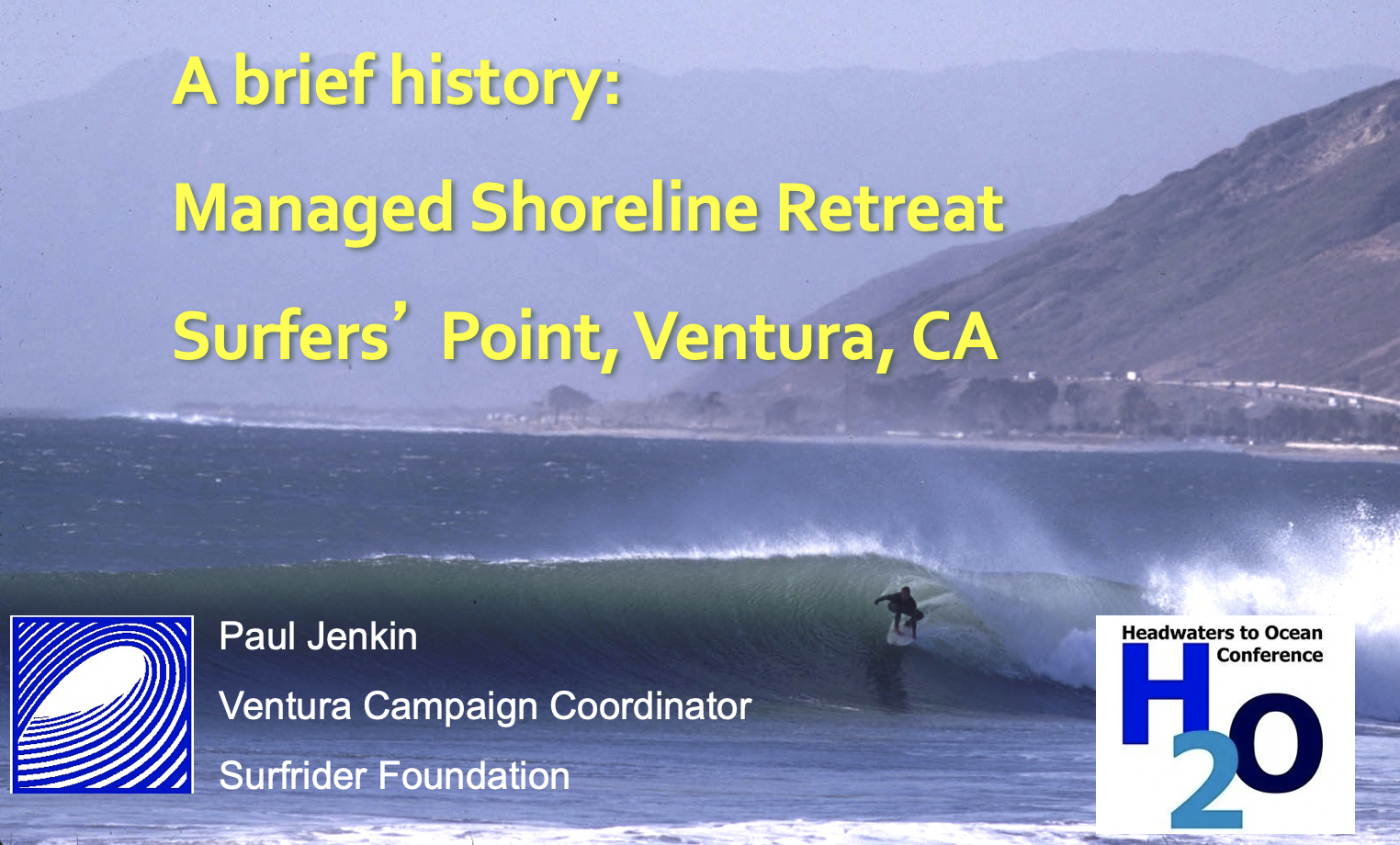
The California Shore and Beach Preservation Association (CSBPA) and Beach Erosion Authority for Clean Oceans and Nourishment (BEACON) organized the 2023 Headwaters to Ocean (H2O) Conference.  This was the first big in-person gathering of professionals involved in watershed and coastal  health, restoration, and management since the COVID pandemic.

On Tuesday November 28, BEACON convened their science advisory panel and stakeholders for a morning meeting followed by lunch and guided tour of the Surfers' Point Managed Shoreline Retreat Project.  

H2O was a two day conference held in the Crowne Plaza Hotel on Ventura Beach on November 29-30. 

The H2O conference serves as a catalyst for collaboration across various fields, industries, institutions, and organizations united by their shared interests in topics related to water, oceans, coastal environments, sediment management, resilience, and the intersections between terrestrial and marine systems.  

A session on Surfers' Point included presentations from Paul Jenkin, Surfrider Foundation, Bob Battalio, ESA, Dave Hubbard, CRC, and Kiki Patsch, CSUCI.  The talks covered the history, engineering, dunes, and monitoring.


Paul Jenkin presented the lunchtime plenary talk, "A Lifetime of Coastal Activism; A Retrospective" or "Headwaters 2 Ocean; Ventura River, a Case Study"


H2O Conference Website: https://asbpa.org/2023/08/15/h2o-2023-conference/


Monday, June 21, 2021

Groundwater Dependent Ecosystems and SGMA

.

Is this a Groundwater Dependent Ecosystem?

People enjoy the last of a drying river on Memorial Day,
Ventura River Preserve 5-31-2021 

Flows rapidly dropped through the Ventura River Preserve this year, leaving the riverbed dry by June.  While this can be a common occurrence in dry years, surface flows are directly related to the groundwater below.  Under the State Groundwater Management Act (SGMA), the local Upper Ventura River Groundwater Sustainability Agency (UVRGSA) has been formed to develop a plan to sustainably manage groundwater into the future.  Draft documents have been released in preparation for a Draft Sustainability Plan later this year.

The question of how to determine whether a reach of the river is "connected" to groundwater, and therefore a "Groundwater Dependent Ecosystem" (GDE) under SGMA, is critical to the future sustainability of our water supply.  When a Groundwater Dependent Ecosystem suffers due to groundwater overdraft, the capacity of the landscape to store water can be compromised.    

The following comments were submitted to the UVRGSA regarding this concern.  The technical documents and other references are linked below. 


DATE: 6-18-2021 RE: Early Comments on Draft Supporting Documents for Upper Ventura River Groundwater Sustainability Plan

This memo is a follow up from our conversation regarding development of the Groundwater Sustainability Plan (GSP). The primary concern we discussed is the elimination of large portions of the basin from SGMA oversight through the assumption that surface water is somehow “disconnected” from groundwater. Apart from the fact that there are fundamental flaws in the methodology used to make this determination, the resulting conclusions and management criteria are not consistent with avoiding undesirable results.

The primary Sustainable Management Criteria (SMC) for the UVRGB is the Depletion of Interconnected Surface Water. The analyses presented to date do not adequately assess the groundwater/surface water interactions within and between the different reaches of the basin, or even acknowledge the impact of groundwater pumping on surface flows.

Screening Groundwater Dependent Ecosystems (GDEs)

The Upper Ventura River Groundwater Basin is a shallow alluvial aquifer integral to the riparian floodplain ecosystem of the main stem Ventura River. Throughout these reaches of the river, groundwater and surface water are connected, and to suggest they are not is to undermine the intent of the Sustainable Groundwater Management Act.

Figure 2. Confirming whether an ecosystem is connected to groundwater, TNC

The Riparian Groundwater Dependent Ecosystems Assessment Report characterizes the Robles reach as a “Losing reach with generally disconnected groundwater- surface water.” This categorization eliminates the majority of this Groundwater Dependent Ecosystem from consideration under SGMA by assuming that it is “disconnected” and thus has too great a depth to groundwater to support riparian habitat. Other reaches are similarly dismissed.

Figure 2 from Riparian Groundwater Dependent Ecosystems Assessment

The analysis presented relies heavily on the Nature Conservancy “Natural Communities (NC) Dataset,” using vegetation communities to eliminate GDE polygons from the Upper Ventura River Groundwater Basin. The NC dataset is a statewide geographic computer database that maps vegetation types in all potential GDEs throughout the State of California. The large geographic scope of this map does not accurately represent current on-the- ground conditions, and more robust ground truthing should be undertaken. Even the aerial photos presented tell a different story than is acknowledged in the narrative (i.e. Figure 6 North Robles Habitat Area Photographs, Aquatic GDE Characterization report)

Figure 6 North Robles Habitat Area Photographs


Unfortunately, the UVRGSA analysis does not fully implement the Best Practices for using the NC Dataset guidance provided by the Nature Conservancy, which presents six best practices for using local groundwater data to confirm whether mapped features in the NC dataset are supported by groundwater. (Best Practices for using the NC Dataset, TNC July 2019)

According to this guidance:  

While depth-to-groundwater levels within 30 feet of the land surface are generally accepted as being a proxy for confirming that polygons in the NC dataset are supported by groundwater, it is highly advised that fluctuations in the groundwater regime be characterized to understand the seasonal and interannual groundwater variability in GDEs. (see Best Practice #2.)

one of the key factors to consider when mapping GDEs is to contour depth-to- groundwater in the aquifer that is supporting the ecosystem (see Best Practice #5).

The GIS Spatial Analysis of Maximum Rooting Depth and Groundwater Level presented in the Riparian GDE document does not present such contour depth-to-groundwater mapping or account for temporal variability.


Figures from Best Practices for using the NC Dataset, TNC


Furthermore, TNC guidance acknowledges that;

In many situations, the hydrologic connection of NC dataset polygons will not initially be clearly understood if site-specific groundwater monitoring data are not available. If sufficient data are not available in time for the 2020/2022 plan, The Nature Conservancy strongly advises that questionable polygons from the NC dataset be included in the GSP until data gaps are reconciled in the monitoring network. Erring on the side of caution will help minimize inadvertent impacts to GDEs as a result of groundwater use and management actions during SGMA implementation.

Many of California’s GDEs have adapted to dealing with intermittent periods of water stress, however if these groundwater conditions are prolonged, adverse impacts to GDEs can result.

Therefore, it is likely that the NC vegetation mapping is representative of conditions in which groundwater levels have been frequently and repeatedly pumped beyond the reach of riparian tree roots. Meanwhile, field observations over the past few wetter years show that the riparian vegetation has rebounded, illustrating how the ecosystem responds with the variation in water years. Receding groundwater levels and corresponding loss of surface flows in the current drought will likely reverse this recent trend, with the potential loss of the many young sycamores.


Determining Groundwater/Surface water interactions

TNC guidance for determining GDEs recognizes the importance of surface flows;

In addition, SGMA requires that significant and undesirable adverse impacts to beneficial users of surface water be avoided. Beneficial users of surface water include environmental users such as plants or animals, which therefore must be considered when developing minimum thresholds for depletions of interconnected surface water.

The Model Results and SMC Implications Presentation (March 25, 2021) reaches the conclusion that:

  • Basin water budget is dominated by streamflow percolation into the Basin and groundwater discharge to Ventura River
  • GW pumping averages only ~10% of the GW Budget As low as 4% in wet years 
Up to 31% in dry years
  • Basin GW levels will be lower in dry seasons, but Basin will still re-fill in normal to wet years

The conclusion that there is no impact from pumping based on the fact that the basin rapidly refills in the wet season points to the likelihood that the surface water is in fact “connected” to groundwater during these periods. Moreover, the fact that pumping represents up to 31% of the budget in the critical dry years raises many questions.


figure from Model Results and SMC Implications Presentation (March 25, 2021)

The Model Results identify four areas of concentrated pumping, three of which directly impact groundwater levels in the “Robles Reach.” This reach is the area with the most storage in the basin, and should be considered as the “primary sub-basin” for water supply. Pumping in this reach directly affects conditions throughout the basin.

The analyses and graphs presented in the Model Results do not provide information on the spacial and temporal surface flow conditions as they relate to groundwater levels. Because the downstream reaches are largely dependent on surface and groundwater flows out of this sub-basin, further analysis is needed to more clearly define the relationship between groundwater levels and surface flows. The analyses should, at a minimum, determine threshold groundwater levels at which surface flows are diminished or eliminated, both in the reach being monitored and downstream.

Groundwater/Surface water interactions
Conjunctive Use Study 1978 


This relationship was established decades ago in the Ventura River Conjunctive Use Report (1978) which states that;

Flows in the live stretch are affected by both the rate of recharge of the upper part of the Ventura River groundwater basin and by the rate of groundwater extraction from wells in the river.

Investigations published in the Conjunctive Use Report identified groundwater elevation thresholds in the upper basin at which flows in the live reach will cease;

when the water level in well 4N23Wl6C4 falls below Elevation 495, surface flow in much of the live stretch stops although some pools remain. A flow of 1 cfs or more in the live stretch corresponds with a water level in this well of greater than about Elevation 507.

Groundwater levels also affect surface flows in the Robles Reach, which frequently dries up despite constant inflows. Unfortunately, the Aquatic GDE Impact Analysis is quick to dismiss the effect of groundwater elevation on surface flows;

No monitoring is recommended at either of the critical riffle aquatic GDEs or the Robles Habitat Area, as impacts from pumping in these areas were determined to be minimal or non-existent.

This conclusion is inconsistent with the guidance provided in Monitoring Networks and Identification of Data Gaps BMP (DWR 2016) which states:

23 CCR §354.34(c))(6): Depletions of Interconnected Surface Water.

Monitor surface water and groundwater, where interconnected surface water conditions exist, to characterize the spatial and temporal exchanges between surface water and groundwater, and to calibrate and apply the tools and methods necessary to calculate depletions of surface water caused by groundwater extractions. The monitoring network shall be able to characterize the following:

(A) Flow conditions including surface water discharge, surface water head, and baseflow contribution.

(B) Identifying the approximate date and location where ephemeral or intermittent flowing streams and rivers cease to flow, if applicable.


(C) Temporal change in conditions due to variations in stream discharge and regional groundwater extraction.

(D) Other factors that may be necessary to identify adverse impacts on beneficial uses of the surface water.

DWR guidance provides detailed information on developing a monitoring network to accurately assess these concerns.


Establishing Minimum Flow Thresholds

As described above, the current GSP analysis incorrectly concludes that groundwater pumping has little to no effect on surface flows throughout the majority of the basin. But even for the identified groundwater dependent “Habitat Areas,” the development of minimum flow thresholds is inadequate. For example;

For the Foster Park Habitat Area, while the City’s low-flow thresholds are based on only one HSI score evaluated in the Padre study (average thalweg depth), we understand this currently provides the best available information to establish minimum thresholds for the depletion of interconnected surface water sustainability criteria.

This statement ignores best available science, including the recently published CDFW Draft Instream Flow Recommendations (2021) as well as the NMFS Draft Biological Opinion for Foster Park Wellfield (2005).


Implications for the UVR Groundwater Sustainability Plan

According to the Brownstein Water Group, the Cuyama Valley Basin and the Paso Robles Area Subbasin GSPs were recently deemed incomplete for deficiencies in their definitions of sustainable management criteria (SMC), including minimum thresholds and undesirable results. Some of the concerns cited by DWR are that the GSP;

  • provides insufficient detail for how it determined that the selected minimum thresholds . . . are consistent with avoiding undesirable results
  • does not relate different minimum thresholds for different portions of the basin to conditions that could cause undesirable results
  • does not sufficiently discuss expected impacts and therefore “precludes meaningful disclosure to, and participation by, interested parties and residents in the Basin.

It is clear from these recent DWR determinations that much more work is needed to develop and present a clear understanding of the workings of the Upper Ventura River Groundwater Basin, the potential impacts from groundwater pumping, and a plan to better manage the limited resource to ensure future sustainability and a healthy ecosystem.


Recommendation:

These initial comments are provided as requested, in good faith, prior to the release of the Draft GSP in the interest of stakeholder engagement and with the hopes that the UVRGSA is able to augment the current analysis and develop a meaningful assessment of the impact of groundwater pumping on surface flows in the Ventura River. It is clear that this will be necessary to successfully develop the Groundwater Sustainability Plan to a level that satisfies the objectives of the Sustainable Groundwater Management Act (SGMA) in order to gain the support of local stakeholders and approval by the California Department of Water Resources.


References:

Upper Ventura River Groundwater Sustainability Agency (UVRGSA) 

Mapping Indicators of GDEs, Groundwater Resource Hub, The Nature Conservancy

IDENTIFYING GDEs UNDER SGMA; Best Practices for using the NC Dataset, The Nature Conservancy, July 2019

Monitoring Networks and Identification of Data Gaps BMP , CA Dept of Water Resources, water.ca.gov

DRAFT ENVIRONMENTAL IMPACT REPORT, VENTURA RIVER CONJUNCTIVE USE AGREEMENT,  Report on the Environmental Impacts of the Proposed Agreement Between Casitas Municipal Water District and the City of-San Buenaventura for Conjunctive Use of the VENTURA RIVER - CASITAS RESERVOIR SYSTEM, Prepared for CMWD and the City,  June 1978

GSAs Shooting 50% on GSPs—DWR Releases First GSP Assessment Results for High Priority Basins, Brownstein Water Group, June 4, 2021


More info:

Sustainable Groundwater Management Act (SGMA)California Department of Water Resources

Groundwater Resource Hub, The Nature Conservancy

Natural Communities Commonly Associated with Groundwater, California Department of Water Resources

Groundwater Dependent Ecosystems - How can we manage groundwater to benefit both people and nature? The Nature Conservancy, scienceforconservation.org


On this blog:

Understanding CDFW Instream Flow Recommendations


Friday, April 16, 2021

Comments on CDFW Instream Flow Recommendations

 Via E-mail to InstreamFlow@wildlife.ca.gov

RE: Comments on CDFW Draft Instream Flow Regime Recommendations for the Lower Ventura River (February 2021)

Dear Mr. Pert,

Thank you for the opportunity to provide comments on the Draft Instream Flow Regime Recommendations. This document has been long anticipated amongst stakeholders engaged in ongoing discussions in the watershed. During this time of unprecedented stress from increased population and climate change, guidance is clearly needed to secure instream flows to maintain riverine ecosystems in California. These diverse and delicate ecosystems support not only native fisheries, most of which are now threatened, but also provide for a quality of life and the very foundation of our economy. The endangered southern steelhead serves as an indicator for how well we manage our land and water, and these instream flow recommendations will help inform ongoing management of our watershed.


Flow Recommendations are difficult to understand

The CDFW Instream Flow Recommendations are the result of a combination of different analytical approaches developed over several years and published in multiple documents. This is necessary in developing a standard approach that applies to the entire State of California, but the result can be difficult to unravel. The outcome and implementation of these recommendations depend on a clear understanding of the approach and intent, not only within the scientific and regulatory communities, but most importantly amongst the diverse stakeholders that currently manage and benefit from the resource.

In the course of our review, two graphics were developed to more clearly illustrate the relationships between the various criteria, methodologies, and recommendations. These graphics and a description of the processes are attached with these comments and published online at https://www.venturariver.org/2021/04/understanding-cdfw-instream-flow.html

The Draft Ventura River Flow Recommendations were derived from Steelhead Passage Flows, Sensitive Period Indicators, and Steelhead Optimum Flows. (The other criteria were developed to provide context based on historical flows in the Ventura River Watershed.)

Therefore, the CDFW Instream Flow Recommendations are primarily based upon the physical properties of the river as determined by Field Methods. The exceptions are two cases where Steelhead Optimum Flows are applied, for Fall Pulse Flows in November (40cfs) and for Adult Migration (80cfs) in Reach 3 only. The latter two recommendations are arbitrary and inconsistent with the other field-based recommendations.


CDFW diverges from established watershed nomenclature

For these studies, CDFW redefined the river and reaches differently from established nomenclature in other watershed planning efforts. For example, much of Reach 3 and all of Reach 4 of CDFW’s “Lower Ventura River” falls within the “Upper Ventura River Groundwater Basin” as defined by the State Groundwater Management Act (SGMA). This nomenclature is likely to create confusion in discussions on implementation of the CDFW Instream Flows Recommendations.


Application of Instream Flow Recommendations is unclear

Stakeholders are confused as to the expectations of the Instream Flow Recommendations in the context of SGMA and other ongoing watershed concerns.

The Department understands these flows to be protective of steelhead and the habitat that supports them and recommends applying them across all water year types. In some cases, the recommended flows may not be available due to precipitation variability. When flows naturally fall below the flow recommendations for the lower Ventura River reaches 2,3, and 4, full natural flows should be maintained. Also, flows higher than the recommended criteria may be beneficial to the ecosystem and to steelhead.

It is unclear how to interpret this statement. Given that the existing condition falls short of the recommended flow in many water years, what is the meaning of “full natural flows should be maintained?” Does this refer to the Natural Flow developed in the Criteria Report (but not published in the Flow Recommendations?) (See comments below on Natural Flow)


Reaches 2/3/4 use different criteria for recommended flows

For the dry months, the differing flow recommendations in these reaches is an artifact of the field study protocols which produce slightly different results based on the varied streambed geometry. Indeed, the consistency of these results is a positive indicator of scientific rigor. A margin of error of 1cfs (6%) would be expected in the natural system, and this is also within the margin of error for the existing gage network (see comment below.)

Flow recommendations for the months of December-May are derived from the steelhead passage criteria (40/33 cfs) in reaches 2 and 3 respectively, while adult migration flows are applied only in reach 4 (80 cfs.) Apart from extractions at Foster park and inflows from Coyote Creek, these 3 reaches exist within the continuum of flows in the river, so 80 cfs in reach 4 would naturally translate to approximately the same flow in the reaches downstream.

Recognizing that these reaches are similar and connected, it may make more sense to apply a common denominator within these reaches to the entire reach as a whole. For example, the Sensitive Period indicator analysis for reaches 2, 3, and 4 resulted in 16, 14, and 15 cfs respectively. It is reasonable to conclude that a threshold of 14 or 15 cfs would indicate sensitivity for the reach as a whole.


The Natural Flows Database is flawed

The “Natural Flows” published in the Watershed Criteria Report are based on the Natural Flows Database for California computer model that attempts to predict unimpaired instream flows for the entire State of California. This model may be applicable to watersheds where snowpack and large reservoirs dominate, but appears to fall short in the groundwater dependent ecosystems of Southern California.

The CDFW Overview document states:

Natural Flows represent flows that would be present in the absence of water use or land use impacts to natural hydrology (Zimmerman et al. 2018). Natural Flows are determined using the estimated Natural Flows Database for California (Zimmerman et al. 2020). These data are used to calculate water month type, Ecosystem Baseflows, and Salmonid Habitat Optimum Flows.

The published literature regarding this computer model (Zimmerman 2017) include the disclaimer;

For some models, poor precision limited the sensitivity of our assessment, making
it impossible to determine whether deviation in flows from expected values was an artefact of the model or evidence of human-caused flow modification. This was 
particularly true for minimum and mean models in the dry season, when natural streamflows are low or absent and are controlled by physical processes that are not represented by basin- scale attributes.
For example, the data suggest that in the 
South Coast of Californiaunderstanding and mitigating the effects of inflated discharge in the summer may be critical

Here the authors admit a lack of understanding as to why the computer model predicts less instream flow than the “inflated discharge” evidenced by the stream gage records. In acknowledgement of this flaw, an “Appendix A” was added to the Watershed Criteria Report to provide an alternative Natural Flow estimation;

Natural Flows Database estimates are provided for every Watershed Criteria Report as part of the effort to produce a consistent statewide dataset. Where appropriate (relatively unimpaired) gage records are available, these site-specific data will be included as an appendix to the report. In these cases, the gage data are considered to replace the Natural Flows Database as an estimate of natural flow conditions.

Indeed, Ventura River flows for the dry months are grossly underestimated by the Natural Flows Database. One explanation may be the inability of the model to account for groundwater-surface water interactions, which are fundamental to the Ventura River. The flows published in Appendix A, derived from a statistical analysis of the “synthetic gage” data for the Ventura River, are significantly higher than those predicted by the Natural Flow database.

For this reason, the Draft Instream Flow Recommendation abandoned the Natural Flows Database, instead using the available historic gage data. Yet neither this document or the Watershed Criteria Report clearly explain the limitations of the Natural Flows information.

The Watershed Criteria Report as published states;

Natural Flows are the streamflows (in cfs) that would be expected with no human influence

Unfortunately, the perpetuation of “Natural Flows” in the CDFW publications is already tainting the public discourse. A recent OpEd published in the Ojai Valley News says:

“The new flow recommendation by the California Department of Fish & Wildlife is 15 cubic feet per second at Foster Park for summertime flows. This is dramatically different from the 1 cfs that the Department of Fish and Wildlife calculates for the same area from July to October of dry years as the “natural flows expected with no human influence” (Watershed Criteria Report No. 2020-01).”


Synthetic gage misrepresents Natural Flow

In place of the Natural Flows Database, these analyses use the synthetic least-impaired USGS gage Ventura R NR Ventura + Div 11118501 based on the period of record 1965– 2007

USGS gage Ventura R NR Ventura + Div , takes the historic USGS flow data and adds back the amount of water diverted through the surface diversion at the City of Ventura’s Foster Park wellfield. (Note that the surface diversion is a fraction of what the total wellfield extracts, and is currently out of commission.)

This “synthetic gage” data is used to develop many of the Watershed Criteria. The historic flow record from the past 40 years is useful in describing the general qualitative flow characteristics in the watershed such as Flow Variation, and to a lesser degree Functional Flows. However, the use of the synthetic gage as currently defined is extremely problematic when attempting to establish a baseline for unimpaired, or “Natural Flows.”

There are three primary concerns with the use of the historic USGS gage data;

First, this data is a record of surface flows just downstream from Foster Park from 1965-2007, which fundamentally represents the developed watershed. Most of the major modifications in the Ventura River Watershed occurred prior to 1965, including the construction of MatiIija Dam in 1948 and Casitas Dam in 1958. It is also important to note that by 1890, before stream gages existed, 4,000 acres of agriculture had already been developed in the Ojai Valley.

Second, a synthetic gage that solely accounts for a single surface diversion disregards the multitude of wells throughout the watershed upstream, all of which detract from the total discharge at Foster Park. The importance of the interaction between groundwater and surface water is recognized by the State of California in the Sustainable Groundwater Management Act. Studies and governance are underway to better define these effects within the Ventura River Watershed. Coordination with the State Water Board’s surface water/groundwater model analysis of unimpaired flows would have been helpful in providing a more robust baseline for instream flows.

Third, stream gaging was historically focused on recording flood events rather than maintaining low flow accuracy. Each flood causes geomorphic alterations to the streambed profile which necessitates re-staging, or re-calibrating, the gages for accuracy. However, until recently very little attention was given to low flows, which are notoriously difficult to measure accurately (i.e. the margin of error may meet or exceed the measured flow.) Other uncontrolled variables such as vegetation growth or human activity can significantly affect gage accuracy. Unfortunately, these variables are not quantifiable in hindsight, so the low flow record has a very high margin of error.

It is important to recognize that the “synthetic gage” does serve as a baseline for the current condition based upon the hydrology of the past 40 years. This 20th century baseline will become most relevant in the coming decades with the increasing pressures of population growth and climate change, as well as to monitor progress with enhanced watershed management.

However, by no means does the synthetic gage represent “the flow that would be present in the absence of land use and water diversion impacts to natural hydrology.” Indeed, it is not only misleading to call these “Natural Flows,” this also undermines any discussion of maintaining or enhancing base flows in the river.

Most importantly, the “Natural Flows” assessment perpetuates the Shifting baseline syndrome“an incremental lowering of standards that results with each new generation lacking knowledge/ observation of the historical (or previous) condition of the environment being observed.”


Recommendations

  • Consolidate flow recommendations for the similar and contiguous reaches 2, 3, and 4.
  • Revise the flow recommendations based on Steelhead Optimum Flows to maintain consistency with flow recommendations based on field methods.
  • Eliminate the flawed Natural Flows Database results from the Criteria Report and revise Natural Flows to reflect the stream gage analysis used in the Flow Recommendations report.
  • Replace the term “Natural Flows” with “Historic Flows” to better represent conditions in the watershed.
  • Update the Natural Flow Criteria as more information comes available from the State Water Board analysis of groundwater-surface water interactions and estimates of unimpaired flow.

We appreciate the opportunity to comment on the Draft Instream Flow Regime Recommendations for the Lower Ventura River and hope these comments are helpful in finalizing these documents.

Sincerely

A.Paul Jenkin
Coordinator, Matilija Coalition
Surfrider Foundation - Ventura County Chapter


On this blog:

Understanding CDFW Instream Flow Recommendations

Ecosystem flows


In the news:

   Ojai leaders don't go with the flow, Ojai Valley News, 5 March 2021 

“These humongous flows by Fish and Wildlife would totally disrupt life in the Ojai Valley,” said Rapp, adding he was particularly alarmed by the agency’s statement that full, natural flows should be maintained when flows fall below the recommendations. “That’s a huge impact. That means for many months of the year, no one should pump their wells, or if someone has diversion rights they should not divert water from the river.”

The decision on what type of instream flow regime is necessary to support a healthy Ventura River is essentially a scientific one, and will not, and should not, be decided by authors of letters to the editor or guest columnists. However, the political will to support and implement whatever scientifically defensible instream flow regime is identified, is very much a matter of public awareness and understanding. Ultimately, the question raised by the current controversy over dividing the waters of the Ventura River is, “What kind of a community do we want to be?” The residents of the Ojai and Ventura River Valleys have an opportunity to set an example for other communities in California and beyond. 

The new flow recommendation by the California Department of Fish & Wildlife is 15 cubic feet per second at Foster Park for summertime flows. This is dramatically different from the 1 cfs that the Department of Fish and Wildlife calculates for the same area from July to October of dry years as the “natural flows expected with no human influence” (Watershed Criteria Report No. 2020-01). 

Three of the largest water users in the Ventura River Watershed — the city of Ventura, Ventura River Water District and Meiners Oaks Water District — have all sent response letters to CDFW regarding the recommendations. All three letters state there’s not enough water in the river to meet Fish and Wildlife’s recommendations.

“The flows that they’ve recommended for steelhead are not available in the river most of the time, so they set these recommended flows that we cannot achieve,” said James Kentosh, vice president of Meiners Oaks Water District.

CDFW’s recommended flows significantly exceed natural, historic flows during all but four months of even the wettest of years, Kentosh told the Ojai Valley News. “If every human being stopped using water in the valley, those flow recommendations would still only be enough a fraction of the time,” he said.  Furthermore, the amounts of water necessary to supplement natural flows to reach recommended flows are too large, according to Bruce Kuebler, board president of VRWD.

Thursday, April 15, 2021

Understanding CDFW Instream Flow Recommendations

The California Department of Fish and Wildlife (CDFW) released Draft instream flow recommendations for the lower Ventura River and Coyote Creek in February 2021.   According to CDFW, "This information will be used to enhance flows in the watershed in several ways, including the development of flow criteria and identification of important flow thresholds for conservation, restoration, and protection of southern steelhead in the Ventura River watershed."


The Draft Flow Recommendations are summarized in the table from the draft document below:
 

Understanding CDFW Instream Flow Recommendations 

The CDFW Instream Flow Recommendations are the result of a combination of different analytical approaches developed over several years and published in multiple documents.  This is necessary in developing a standard approach that applies to the entire State of California, but the result can be difficult to unravel.  The outcome and implementation of these recommendations depend on a clear understanding of the approach and intent, not only within the scientific and regulatory communities, but also amongst the diverse stakeholders that currently manage and benefit from the resource.  

In order to better understand the origin of these flow recommendations, two graphics were developed to more clearly illustrate the relationships between the various criteria, methodologies, and recommendations.  These graphics and a description of the processes are shown below.


The Summary Chart consolidates all of the values published in the Draft instream flow recommendations document, each aligned by month so that they can be easily viewed and cross referenced.  At the top of this chart is the general Functional Flow diagram from the Watershed Criteria Report with the Ventura River specific values inserted for each functional flow component.  The other watershed criteria are shown in the boxes below, color coded for consistency with the CDFW documentation.  


But where did this information come from?  


The Summary of Watershed Criteria Methodology table illustrates how each of the watershed criteria were derived.  
  • Stream gage records are used to develop a statistical analysis of flows in the Ventura River which become the basis for understanding Flow Variation and Functional Flow.  
  • A computer model was used to develop the Natural Flows criteria, from which Ecosystem Baseflow and Salmonid Habitat Optimum Flows were derived.   
  • Field methods were applied to  determine Sensitive Period Indicators and Steelhead Passage Flows.

Note that due to obvious inaccuracies in the statewide "Natural Flows Database" computer model, the analysis for the Ventura River use the "synthetic least-impaired USGS gage Ventura R NR Ventura + Div 11118501 based on the period of record 1965–2007."  This data is included in Appendix A of the Watershed Criteria Report No. 2020-01 Version 2, updated May 2020.

As illustrated in the Summary Chart above, the Ventura River Flow Recommendations were derived from Steelhead Passage Flows, Sensitive Period Indicators, and Steelhead Optimum Flows.   (The other criteria were developed to provide context based on historical flows in the Ventura River Watershed.) 

Therefore, the CDFW Instream Flow Recommendations are primarily based upon the physical properties of the river as determined by Field Methods.  The exceptions are two cases where Steelhead Optimum Flows are applied, for Fall Pulse Flows in November (40cfs) and for Adult Migration (80cfs) in Reach 3 only.


Field Methods Overview


CDFW Staff surveyed a total of 22 riffle transects on San Antonio Creek and the lower Ventura River. Fifteen of the original riffle transects surveyed for this project were included in the final analysis. These transects were used to develop both Sensitive Period Indicators and Steelhead Passage Flows. 


The Wetted Perimeter Method is a field survey used to determine the Sensitive Period Indicator, which is "threshold flows below which the ecosystem is likely to be particularly sensitive to additional flow reductions and other stressors." 

Once wetted perimeters and associated flows for the streambed cross-sections are obtained for the range of important flows, a wetted perimeter discharge curve is developed by plotting wetted perimeter against discharge. The breakpoint and incipient asymptote, as thresholds of important habitat conditions, are then identified to determine instream flow needs necessary for maintaining ecological and riffle productivity flows.  The Sensitive Period Indicator flow must produce a wetted perimeter that covers at least 50% of the bankfull channel perimeter in streams up to 50 feet wide and 60–70% in wider streams.


An example of this method is shown below (taken from AppendixB) for a transect of the Ventura River.  In this location it was determined that 16 cfs is the breakpoint below which the river is sensitive to flow reduction and other stressors.

The Habitat Retention Method is used to determine Salmonid Passage Flows. This method seeks to identify flows required to permit salmonid passage across the shallowest part of a channel, the hydraulic control.  Passage Flows for juvenile steelhead must produce a mean depth of 0.4 feet at the hydraulic control, while also meeting additional criteria for wetted perimeter or flow to preserve connectivity between mesohabitat units.


REFERENCE:


On this Blog:


Wednesday, October 7, 2020

Beavers


There has been a considerable amount of scientific and on-the-ground research since the previous post on Re-Beavification.  This topic was met with tremendous skepticism, and outright scorn from some during the development of the Ventura River Watershed Plan.  However, new information lends credence to the idea that re-introduction of beaver to the watershed could provide significant benefits and even resolve some of the ongoing conflict over water supply.

There is a growing understanding of the concept of "slow it, spread it, sink it" as a tool in protecting and improving groundwater resources.   In general this applies to our land management practices, where shifting away from impervious "pave it and drain it" practices helps put water back in the ground.  But just as important, we should consider how past changes in our rivers and creeks have also impacted the amount of water stored underground.  

In this video, National Forest hydrologist Kami Elison explains the benefits of "Living with Beaver"


The Return of California's Golden Beaver: 


Are Beavers native to the Ventura River?

Many do not realize that before the "Gold Rush" trappers scoured every nook and cranny of the state during the "California Fur Rush."  Of course the nearby Channel Islands was a treasure trove of fur seals and sea otters, but trappers also went up the rivers for beaver.  This is described in this wikipedia article on the history of beavers in California.  As part of their Bring Back the Beaver CampaignKate Lundquist and Brock Dolman co-authored The Historical Range of Beaver in Coastal California, a peer-reviewed scientific paper re-evaluating the historic evidence of beaver on the coast of California. Ventura County is included in this research.

Why are Beavers important?

Beavers are nature's engineer, and their removal from our coastal rivers had a drastic effect on the ecosystem.  North American beaver (Castor canadensis) are what biologists call a “keystone species” as the habitat they create benefits many other species. Their dams improve water quantity and quality, increase late season flow and reduce the impacts of flooding. Beaver bank burrows and food caches provide critical habitat for many native and endangered California species. 

Here is what the Water Institute of the Occidental Art and Ecology Center has to say:

“Extensive research has recently heightened recognition of the important role beaver (Castor canadensis) can play in watershed health and climate change resiliency. The species’ ecological services include enhanced water storage, erosion control, habitat restoration and creation, listed species recovery, the maintenance of stream flows during the dry summer period, and other beneficial adaptations to our changing climate conditions."

Despite these benefits, current California beaver policy solely focuses on recreational hunting and lethal nuisance management. In response, the WATER Institute launched a Bring Back the Beaver Campaign to educate citizens about the importance of beaver. In order to improve water supply for humans and the environment and increase resilience to drought and climate change, we are working to integrate their management into California policy and regulation.

In addition to the resources on OAEC's site, the Beaver Institute has a large library of technical reference on everything from biodiversity and climate change, to experiments with man-made "Beaver Dam Analogs" that have been demonstrated to restore streams.  

Interestingly, visitors to the Ventura River have shown a tireless propensity for building pools in which to cool off in the hot months.  These human dams may in fact be a form of Beaver Dam Analog, slowing the flow, and perhaps even helping to increase our precious groundwater supply. 

Ventura River "Beaver Dam Analog" (BDA)


Below is a list of references and articles for those interested in learning more:

Bring Back the BeaverOccidental Art and Ecology Center

Beaver Institute

The Beaver Coalition empowers humans to partner with beavers through education, science, advocacy, and process-based restoration. We are proud to be the new stewards of “The Beaver Restoration Guidebook"

Keep Me Wild: Beaver:  California Department of Fish and Wildlife 

 'We became beavers' US Fish and Wildlife Service Partnering with the Scott River Watershed Council, designed a project to simulate what beavers had not been around to do for decades

Role of Beaver in Stream Ecosystems: Overview of beaver life history and habitat requirements, presentation from NOAA Northwest Fisheries Science Center

Why Beavers are Worth a Dam!  Environmental Protection Information Center (EPIC) advocates for statewide beaver relocation program

Beavers—Once Nearly Extinct—Could Help Fight Climate Change National Geographic; Beaver ponds keep rivers and streams wet all year, compensating for less snowpack and glacial melt. We just need to stay out of their way.

The Bountiful Benefits Of Bringing Back The Beavers, NPR Weekend Edition

Bring Back The Beavers  article includes video "How Beavers Engineer the Land" 

The Martinez Beavers: Worth A Dam

There's A Proposal To Bring Beavers To L.A. To Help With The Drought

Ranchers_Friend_and_Farmers_Foe_Reshaping_Nature_with_Beaver_Reintroduction _in_California

Beaver reintroduction key to solving freshwater biodiversity crisis

LEAVE IT TO BEAVERS: SIGNIFICANT PARTNERS IN DEALING WITH CLIMATE CHANGE 

Study: Beavers Transform Forests into Wetlands Over Many Decades

The British solution to beat flooding: Bring back beavers

Beavers set to be released in London as part of urban rewilding, Citizen Zoo plans to reintroduce animals in Tottenham as part of effort to ‘beaver up’ the capital, The Guardian, July 2, 2021 - The current law only allows landowners to release beavers if they are kept in a fenced enclosure. However, the government is developing a national beaver strategy that campaigners hope will include a roadmap for tearing these fences down

HYDROLOGIC RESPONSE OF HEADWATER STREAMS RESTORED WITH BEAVER DAM ANALOGUE STRUCTURES Masters Thesis By Evan Graham Norman 

Leave it to Beavers, NATURE documentary on PBS (Full episode streams on Amazon Prime)

Beavers Are Firefighters Who Work for Free, Is it time to rethink beaver relocation bans?, Sierra Magazine, May 4, 2021  "sections of creek that did not have beavers were on average more than three times as affected by fire—burning a bigger area—than areas where beavers had built dams."

Smokey the Beaver: beaver-dammed riparian corridors stay green during wildfire throughout the western United States, Emily Fairfax & Andrew Whittle, 2020

Klamath Tribes want beavers back in the Beaver State, Reintroducing the species creates important habitat for First Foods. But state laws don’t work in the animal’s favor. High Country News, May 19, 2021

The Economic History of the Fur Trade: 1670 to 1870,  Economic History Association "But after the 1730s there was a decline in beaver stocks to about half the maximum sustained yield levels. The cause of the depletion was closely related to what was happening in Europe. There, buoyant demand for felt hats and dwindling local fur supplies resulted in much higher prices for beaver pelts. These higher prices, in conjunction with the resulting competition from the French in the Hudson Bay region, led the Hudson’s Bay Company to offer much better terms to Natives who came to their trading posts (Carlos and Lewis, 1999).

Here, we define river-wetland corridors as a river type; review paleoenvironmental and historical records to establish their past ubiquity; describe the geologic, biotic, and geomorphic processes responsible for their formation and persistence; and provide examples of river-wetland corridor remnants that still survive. We close by highlighting the significance of the diverse river functions supported by river-wetland corridors, the consequences of diminution and neglect of this river type, and the implications for river restoration.

The beavers returning to the desert, BBC FUTURE PLANET | RIVERS, 13th July 2021
As the world heats up and extreme weather becomes more frequent, scientists have been rushing to reintegrate beavers into struggling ecosystems and dry landscapes.  Beavers used to be a prevalent species worldwide, ranging from Scotland to Spain, Syria to Russia, Canada to Mexico. The fur trade of the 1500s to 1800s saw the creatures hunted to almost extinction, but a recent resurgence of research and lobbying by conservationists has seen their numbers climb again.

Beaver expert Dr. Emily Fairfax said protecting these animals is crucial. She’s a hydrologist and teaches environmental science and resource management at California State University (CSU) Channel Islands.  She’s been studying a beaver habitat in the Salinas River over the past year and a half. She said she has seen the riverbed change from dry and sandy to a productive wetland.

To improve wildfire resistance, researchers look to beavers, Heard on NPR's All Things Considered, Oct 16, 2021
Last year Colorado saw the two largest wildfires in it's history, destroying hundreds of homes and 600 square miles of forest. Largely unbothered, though, are beavers, whose wet habitats offer refuge.

All of Ventura County is part of the historical habitat of beavers. TsĒ’ pĒk is the Chumash word for beaver, and there are at least two places in Ventura County named after the animal. Beaver Campground and Beaver Camp are approximately northwest of the Ventura River where it nears the Pacific Ocean. Is it possible to reintroduce beavers? “It is realistic. It’s something that people are already doing in other states like Colorado,” Fairfax said. “It’s common in Washington, you can do it in Oregon.”  But not in California currently.  “It’s illegal here. You can’t move a live beaver for that purpose.”